Five-Year Plan
-
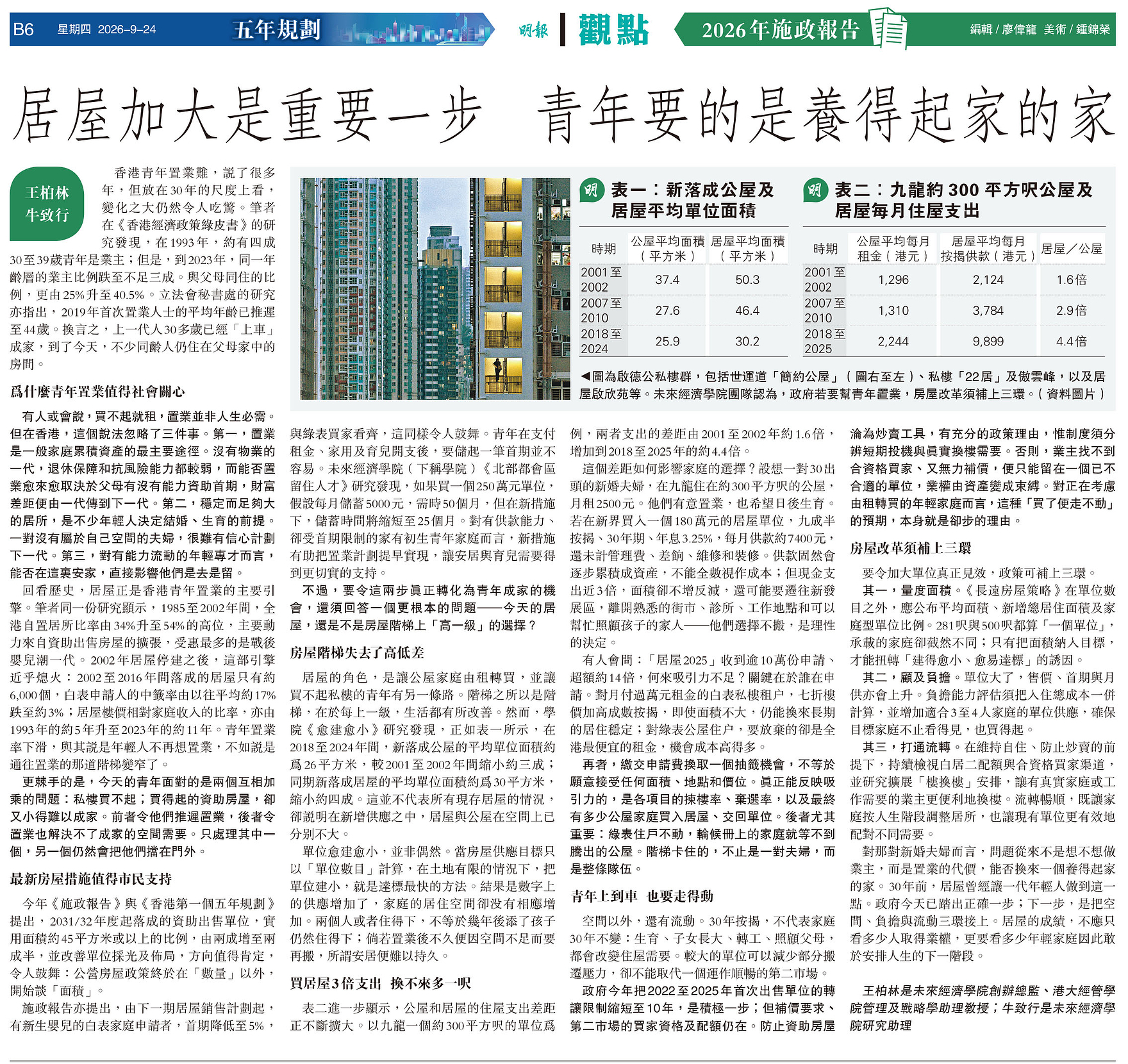
Larger HOS Flats Are an Important Step — Young People Need Homes Where They Can Afford to Raise a Family
Abstract: Hong Kong’s homeownership rate among younger households has fallen substantially, while smaller newly built subsidised flats and rising housing costs have weakened the appeal of moving up the housing ladder. This article argues that the Government’s move to provide more larger subsidised sale flats and lower down-payment requirements for some young families is an important step, but lasting reform must also address living space, affordability and housing mobility so that homeownership can provide a home in which young families can build their lives. The difficulty young people in Hong Kong face in buying a home has been discussed for many years. Yet, viewed over a 30-year period, the scale of the change remains striking. Our research for the Hong Kong Economic Policy Green Paper found that in 1993, around 40% of people aged 30 to 39 were homeowners. By 2023, the homeownership rate among the same age group had fallen to below 30%. Over the same period, the proportion living with their parents rose from 25% to 40.5%. Research by the Legislative Council Secretariat also found that, by 2019, the average age of first-time homebuyers had risen to 44. In other words, while many in the previous generation had already bought a home and started a family in their thirties, many people of the same age today are still living in a room in their parents’ home. Why Youth Homeownership Matters Some may argue that those who cannot afford to buy can simply rent, and that homeownership is not a necessity in life. In Hong Kong, however, this argument overlooks three important considerations. First, homeownership is the principal means through which ordinary families accumulate assets. A generation without property ownership has weaker retirement security and less capacity to withstand financial shocks. At the same time, whether young people can afford to…
-
From Colonial Governance to Aligning with National Planning: Hong Kong Must Build a Policy Research Ecosystem
Hong Kong’s 156 years of British rule left it with no tradition of long-term planning, and the post-handover efforts to build policy research capacity remain inadequate for aligning with national five-year planning. The authors argue that the SAR must now treat local policy research as core infrastructure — backed by redesigned public funding, opened commissioning pipelines, and a sustained talent pipeline.
-
Planning Is Not Consultation: The Real Test of Hong Kong’s First Five-Year Plan
Hong Kong’s first Five-Year Plan will be judged not by the document produced but by the planning capacity built along the way. The real challenge is that genuine planning requires sustained, professional policy research — the very thing Hong Kong has yet to develop.
-
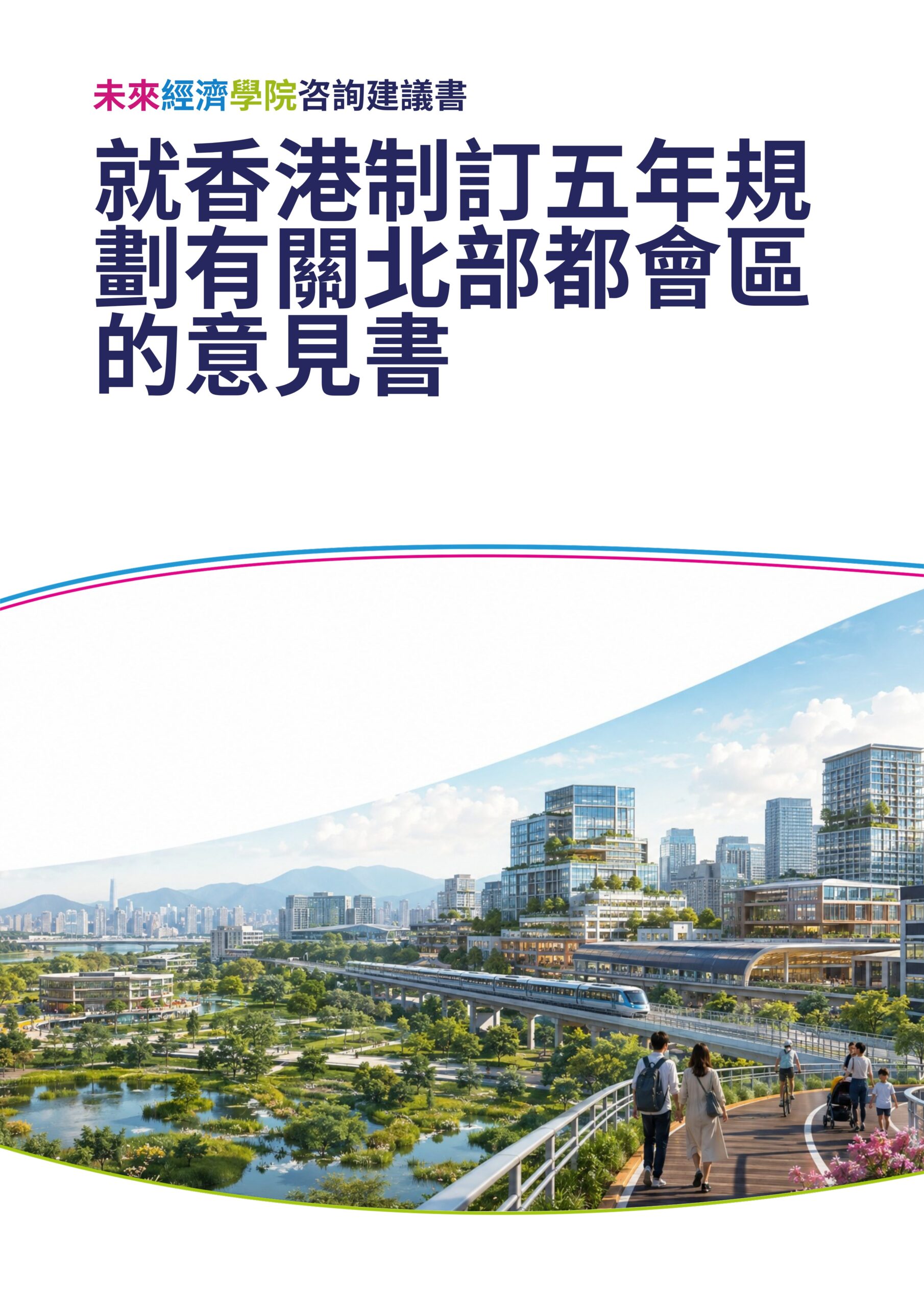
《Submission on the Northern Metropolis for Hong Kong’s Five-Year Plan》
The Northern Metropolis is Hong Kong’s largest spatial development project since the establishment of the HKSAR. It will not only accommodate a substantial share of the city’s future land and housing supply, but also serve as a critical platform for connecting with the Guangdong–Hong Kong–Macao Greater Bay Area, developing innovation and technology, attracting talent and supporting young people in establishing homes. The development of the Northern Metropolis should therefore proceed with determination. Its success, however, should not be measured solely by the completion of site formation, housing and infrastructure projects. The real challenge is to transform the Northern Metropolis from a construction project into both a lifestyle choice and a market choice—a place where residents want to settle, businesses want to invest, and educational and research institutions want to establish a presence. In recent years, the Government has introduced a range of supply-side reforms relating to high-level coordination, land tendering, approval procedures and construction timelines. These efforts are moving in the right direction. Nevertheless, demand for commercial land and private-sector investment remains weak, suggesting that increasing the supply of land and housing alone may not be sufficient to create a vibrant new metropolitan area. If the first groups of residents have an overly homogeneous demographic and income profile, while employment, education, commerce, transport and community facilities fail to develop in tandem, the Northern Metropolis may repeat the early experience of some new towns, where residents moved in before adequate supporting facilities were available. It could ultimately become a “dormitory town” to which residents return only in the evening, or an inefficient district in which residential, industrial and commercial functions remain disconnected. The Institute recommends that the next phase of Northern Metropolis policy move beyond supply-side construction towards demand activation, demographic planning and the integration of urban functions. Public housing in…
-

《Submission on Housing Policy for Hong Kong’s Five-Year Plan》
Hong Kong’s public housing system has historically served not only as a housing safety net, but also as a ladder of upward mobility—from public rental housing to subsidised home ownership and eventually to private housing. It has played an important role in the formation of the middle class, social mobility and economic development. However, following the substantial contraction of subsidised home ownership and overall housing supply after 2002, this housing ladder has gradually broken down. Young people and middle-income households have long found themselves caught in a difficult position: unable to afford private housing, unsuccessful in obtaining subsidised sale flats and unable to improve their living conditions. This has impeded home ownership and asset accumulation while weakening confidence in starting families, having children, remaining in Hong Kong and working towards a better future. The performance of the current housing policy is measured primarily by the waiting time for public rental housing and the number of units constructed. Although these indicators are useful for monitoring basic supply, they do not fully capture the problems that residents actually face. Housing affordability in Hong Kong has continued to deteriorate, the home ownership rate among young people has declined and the average size of residential units has continued to shrink. At the same time, turnover in the Home Ownership Scheme Secondary Market remains low. A large number of subsidised sale flats are subject to restrictions on resale, premium payments and leasing, preventing them from being reallocated according to changing household needs. Some higher-income public rental housing tenants also remain in the system for extended periods because of the lack of an affordable pathway to home ownership. These are no longer merely livelihood issues; they are structural problems that directly affect talent attraction, household formation, labour supply, the allocation of public resources and fiscal sustainability.…
-

《Submission on Industrial and Technological Development for Hong Kong’s Five-Year Plan》
Hong Kong is currently formulating its first Five-Year Plan to align with the National 15th Five-Year Plan. Innovation and technology (I&T) is not only a major driver of the country’s development of new quality productive forces, but also essential to Hong Kong’s economic transformation and international competitiveness. Hong Kong should fully leverage the institutional advantages of “One Country, Two Systems” by integrating its strengths in university research, international finance, professional services and global business networks with the industrial supply chains, manufacturing capabilities and extensive market of Shenzhen and the Guangdong–Hong Kong–Macao Greater Bay Area. In doing so, Hong Kong can integrate more proactively into—and contribute more effectively to—the country’s overall development. Over the past two decades, Hong Kong has recorded increases in both research and development (R&D) expenditure and the number of research personnel, while the academic and fundamental research capabilities of its universities have also improved significantly. Nevertheless, Hong Kong’s R&D expenditure as a share of GDP remains lower than that of many leading innovation economies, with particularly inadequate investment from the private sector. Although Hong Kong ranks highly in “innovation inputs” under the Global Innovation Index, its performance in “innovation outputs” is relatively weak. This suggests that its existing institutional, financial, talent and research strengths have yet to be fully translated into technological achievements, commercial applications and business-led innovation. While the number of start-ups in Hong Kong has continued to grow, many still face constraints arising from the limited size of the local market, difficulties in scaling up and challenges in retaining talent over the long term. Hong Kong’s future I&T positioning should not focus solely on increasing government funding or replicating the Mainland’s model of industrial development. Instead, it should concentrate on the functions in which Hong Kong is most competitive. The Five-Year Plan should support Hong…
-
Hong Kong’s Five-Year Plan: Lessons from Singapore and South Korea’s Capitalist Market Planning Models?
Drawing on the planning experience of South Korea and Singapore, this article argues that Hong Kong’s version of the five-year plan should focus on long-term structural issues and a practical strategic blueprint, rather than rigid GDP targets and an all-encompassing wish list.
-
Hong Kong’s Five-Year Plan Maiden Voyage: Building a More Mature and Open Space for Public Policy Discussion
Chief Executive John Lee has announced that Hong Kong will draw up its own Five-Year Plan for the first time, in a deliberate governance shift from year-by-year policy to medium-term planning. The authors argue that the plan’s real significance is whether Hong Kong can, through this process, build a more mature approach to governance — grounded in data and empirical research, integrated through a systems-engineering perspective, and underpinned by a revitalised think-tank ecosystem capable of supporting a more mature and open public policy discussion space.