
Abstract: Hong Kong’s homeownership rate among younger households has fallen substantially, while smaller newly built subsidised flats and rising housing costs have weakened the appeal of moving up the housing ladder. This article argues that the Government’s move to provide more larger subsidised sale flats and lower down-payment requirements for some young families is an important step, but lasting reform must also address living space, affordability and housing mobility so that homeownership can provide a home in which young families can build their lives.
The difficulty young people in Hong Kong face in buying a home has been discussed for many years. Yet, viewed over a 30-year period, the scale of the change remains striking. Our research for the Hong Kong Economic Policy Green Paper found that in 1993, around 40% of people aged 30 to 39 were homeowners. By 2023, the homeownership rate among the same age group had fallen to below 30%. Over the same period, the proportion living with their parents rose from 25% to 40.5%. Research by the Legislative Council Secretariat also found that, by 2019, the average age of first-time homebuyers had risen to 44. In other words, while many in the previous generation had already bought a home and started a family in their thirties, many people of the same age today are still living in a room in their parents’ home.
Why Youth Homeownership Matters
Some may argue that those who cannot afford to buy can simply rent, and that homeownership is not a necessity in life. In Hong Kong, however, this argument overlooks three important considerations.
First, homeownership is the principal means through which ordinary families accumulate assets. A generation without property ownership has weaker retirement security and less capacity to withstand financial shocks. At the same time, whether young people can afford to buy a home increasingly depends on whether their parents can help with the down payment, allowing wealth inequality to be passed from one generation to the next.
Second, a stable home with sufficient space is, for many young people, a prerequisite for deciding whether to marry and have children. It is difficult for a couple without a space of their own to plan confidently for the next generation.
Third, for young professionals who have the ability to move elsewhere, whether they can establish a home in Hong Kong directly affects their decision to stay or leave.
Looking back, the Home Ownership Scheme (HOS) was a major engine of homeownership among younger people in Hong Kong. The same research found that between 1985 and 2002, Hong Kong’s overall homeownership rate rose from 34% to a peak of 54%, driven largely by the expansion of subsidised sale housing, with the post-war baby-boom generation benefiting most.
After HOS construction was suspended in 2002, however, this engine almost came to a halt. Only around 6,000 HOS flats were completed between 2002 and 2016. The success rate for White Form applicants fell from an earlier average of around 17% to approximately 3%, while the ratio of HOS prices to household income rose from around five years of income in 1993 to around 11 years in 2023. Rather than suggesting that young people no longer want to own homes, the decline in youth homeownership suggests that the path towards ownership has become much narrower.
More difficult still, young people today face two problems that reinforce each other: private housing is unaffordable, while the subsidised housing they can afford may be too small for starting a family. The former delays homeownership; the latter means that even buying a home may not solve their need for adequate family living space. Addressing only one of these problems still leaves the other standing in their way.
The Latest Housing Measures Deserve Public Support
This year’s Policy Address and Hong Kong’s First Five-Year Plan propose that, for subsidised sale flats completed from 2031/32 onwards, the proportion with a saleable area of around 45 square metres or more will increase from 20% to 25%, alongside improvements in natural lighting and flat layouts. This is a welcome and encouraging direction: public housing policy is finally beginning to discuss not only the number of flats, but also their size.
The Policy Address also proposes that, starting from the next HOS sale exercise, White Form family applicants with newborn babies will be able to make a down payment of just 5%, bringing them in line with Green Form buyers. This is equally encouraging. After paying rent, household expenses and childcare costs, it is not easy for young people to accumulate a substantial down payment.
Research by the Future Economy Institute (FEI), Retaining Talent in the Northern Metropolis, found that for a flat costing HK$2.5 million, assuming monthly savings of HK$5,000, accumulating the required down payment would take 50 months. Under the new measure, that period would be shortened to 25 months. For young families with newborns who have the capacity to service a mortgage but are constrained by the initial down payment, the measure can bring homeownership within reach sooner and provide more tangible support for both housing and child-rearing needs.
Yet, if these two measures are to translate into genuine opportunities for young people to start families, a more fundamental question remains: does HOS housing today still represent a genuine “step up” on the housing ladder?
The Housing Ladder Has Lost the Distance Between Its Rungs
The role of HOS housing is to enable public rental housing (PRH) households to move from renting to ownership, while providing another route for young people who cannot afford private housing. A ladder works because moving up each rung should bring some improvement in living conditions.
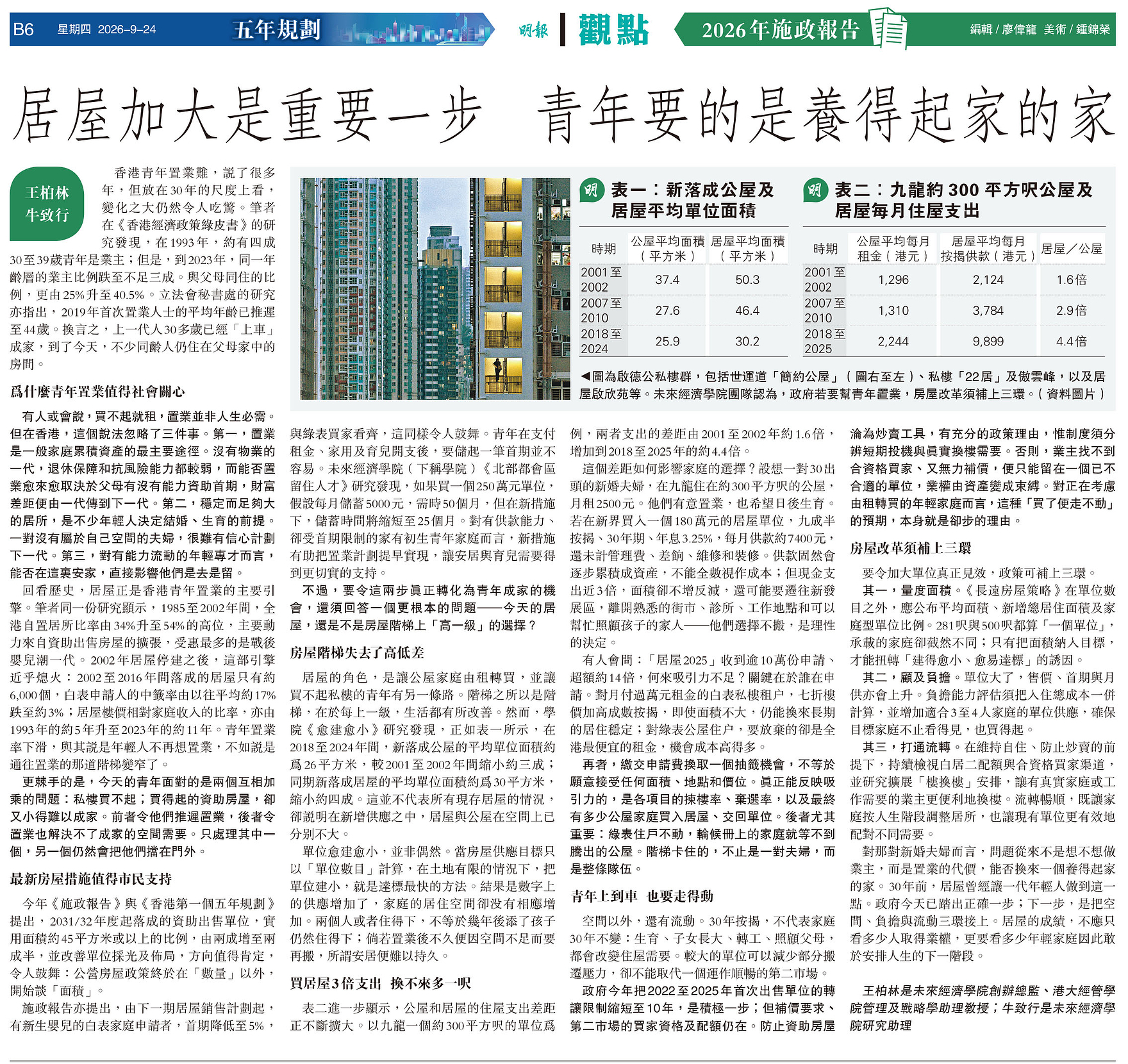
However, FEI’s Smaller and Smaller study found that, as shown in Table 1, the average size of newly completed PRH flats between 2018 and 2024 was around 26 square metres, approximately 30% smaller than in 2001–02. Over the same period, the average size of newly completed HOS flats was around 30 square metres, approximately 40% smaller than in 2001–02. This does not describe every existing HOS flat, but it does show that among new housing supply, the difference in living space between HOS and PRH flats has become relatively small.
The trend towards smaller flats is not accidental. When housing supply targets are measured only by the number of units, reducing unit sizes becomes one of the quickest ways to meet those targets when land is limited. The result is that housing supply increases on paper, while the amount of living space available to families does not increase correspondingly.
A flat that is large enough for two people today may no longer be adequate when they have a child several years later. If a family has to move again shortly after buying because there is not enough space, the stability that homeownership is supposed to provide becomes difficult to sustain.
Three Times the Housing Outlay, Without an Extra Square Foot
Table 2 further shows that the gap in housing expenditure between PRH and HOS has continued to widen. Taking a roughly 300-square-foot flat in Kowloon as an example, the ratio between HOS and PRH housing expenditure increased from around 1.6 times in 2001–02 to approximately 4.4 times in 2018–25.
What does this gap mean for a family’s decisions? Consider a newly married couple in their early thirties living in a roughly 300-square-foot PRH flat in Kowloon and paying HK$2,500 a month in rent. They would like to buy a home and hope to have children in the future.
If they buy an HOS flat in the New Territories for HK$1.8 million with a 95% mortgage, a 30-year repayment period and an annual interest rate of 3.25%, their monthly mortgage payment would be around HK$7,400. This does not yet include management fees, rates, maintenance or renovation costs.
Mortgage repayments, of course, gradually build up an asset and therefore cannot be treated entirely as a cost. But the couple’s monthly cash outlay would still rise to almost three times its previous level, while their living space might remain unchanged or even become smaller. They might also have to move to a new development area, leaving behind familiar markets and clinics, their workplaces, and family members who could help care for their children. Under these circumstances, choosing not to move is a rational decision.
Some may ask: if HOS housing is becoming less attractive, why did HOS 2025 receive more than 100,000 applications and become around 14 times oversubscribed? The key question is who is applying.
For White Form applicants paying more than HK$10,000 a month to rent in the private market, a flat sold at a 30% discount with a high loan-to-value mortgage can offer long-term housing stability even if the flat itself is not large. For Green Form PRH households, however, what they must give up is some of the cheapest rental housing in Hong Kong. Their opportunity cost is much higher.
Moreover, paying an application fee for the chance to enter a ballot is not the same as being willing to accept any flat regardless of its size, location or price. Better indicators of attractiveness are the flat-selection rate and the rate at which applicants decline offers, as well as, ultimately, how many PRH households actually purchase HOS flats and surrender their PRH units.
The last measure is particularly important. If Green Form households do not move, families on the PRH waiting list cannot gain access to the units they would otherwise vacate. When the housing ladder becomes stuck, it affects not only one couple, but the entire queue behind them.
Getting on the Housing Ladder Is Not Enough — Young Families Must Be Able to Move Along It
Beyond space, there is also the question of mobility. A 30-year mortgage does not mean that a family remains unchanged for 30 years. Having children, children growing up, changing jobs and caring for ageing parents can all alter a household’s housing needs. Larger flats can reduce some of the pressure to move, but they cannot replace a well-functioning secondary market.
This year, the Government shortened the transfer restriction period to 10 years for flats first sold between 2022 and 2025, which is a positive step. However, requirements concerning premium payments, buyer eligibility in the secondary market and quotas remain.
There are sound policy reasons for preventing subsidised housing from becoming a vehicle for speculation. Yet the system must distinguish between short-term speculation and genuine needs to move home. Otherwise, an owner who cannot find an eligible buyer and cannot afford to pay the land premium may have no choice but to remain in a flat that no longer suits the family. Homeownership can then turn from an asset into a constraint. For young families considering whether to move from renting to ownership, the prospect of being “locked in” after buying is itself a reason for hesitation.
Housing Reform Must Complete Three Links
If larger flats are to make a real difference, housing policy needs to complete three further links.
First, measure space. Alongside the number of housing units, the Long Term Housing Strategy should publish the average unit size, the total amount of new residential floor space provided, and the proportion of family-sized flats. A 281-square-foot flat and a 500-square-foot flat both count as “one unit”, but the kinds of families they can accommodate are very different. Only by incorporating floor area into housing targets can the incentive that makes smaller flats easier for meeting numerical targets be reversed.
Second, take affordability into account. Larger flats also mean higher prices, larger down payments and higher monthly mortgage payments. Affordability assessments should therefore consider the total cost of occupation, while the supply of flats suitable for three- to four-person households should be increased. The aim should be to ensure that target families can not only see these homes being built, but can actually afford them.
Third, improve mobility. While maintaining owner-occupation requirements and safeguards against speculation, the Government should continue reviewing the quota under the White Form Secondary Market Scheme and the channels through which eligible buyers can enter the market. It should also explore expanding flat-for-flat arrangements so that owners with genuine family or employment needs can move home more easily. A more fluid system would allow families to adjust their housing as they move through different stages of life, while enabling the existing housing stock to be matched more efficiently with households of different needs.
For the newly married couple in our example, the question has never simply been whether they want to become homeowners. The real question is whether the price of homeownership can buy them a home in which they can afford to raise a family.
Thirty years ago, HOS housing enabled a generation of young people to do precisely that. The Government has now taken an important step in the right direction. The next step is to connect the three links of space, affordability and mobility. The success of HOS should not be measured only by how many people acquire property ownership, but by how many young families it enables to move confidently into the next stage of their lives.
(Translation supported by AI)