March 2026 | Hong Kong Amid the Middle East Conflict
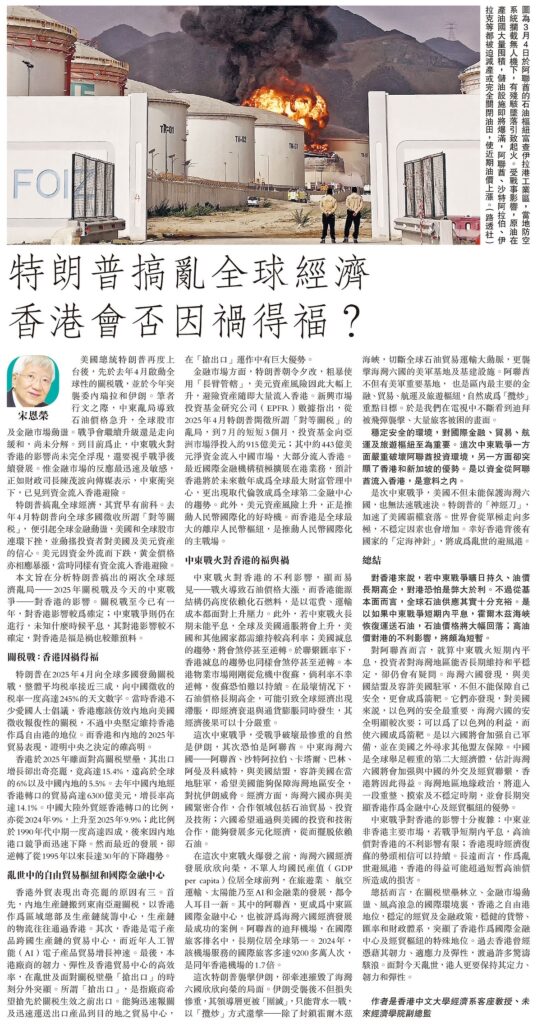
US President Donald Trump’s tariff war, together with the escalating conflict in the Middle East, has dealt a blow to the global economy. We examine the risks and opportunities facing Hong Kong amid this turmoil. While external risks are rising, the crisis may also further highlight Hong Kong’s role as a free port, an international financial centre, and an offshore renminbi hub.
- 特朗普搞亂全球經濟香港會否因禍得福? by Yun-wing Sung
February 2026 | Hong Kong Five-Year Plan
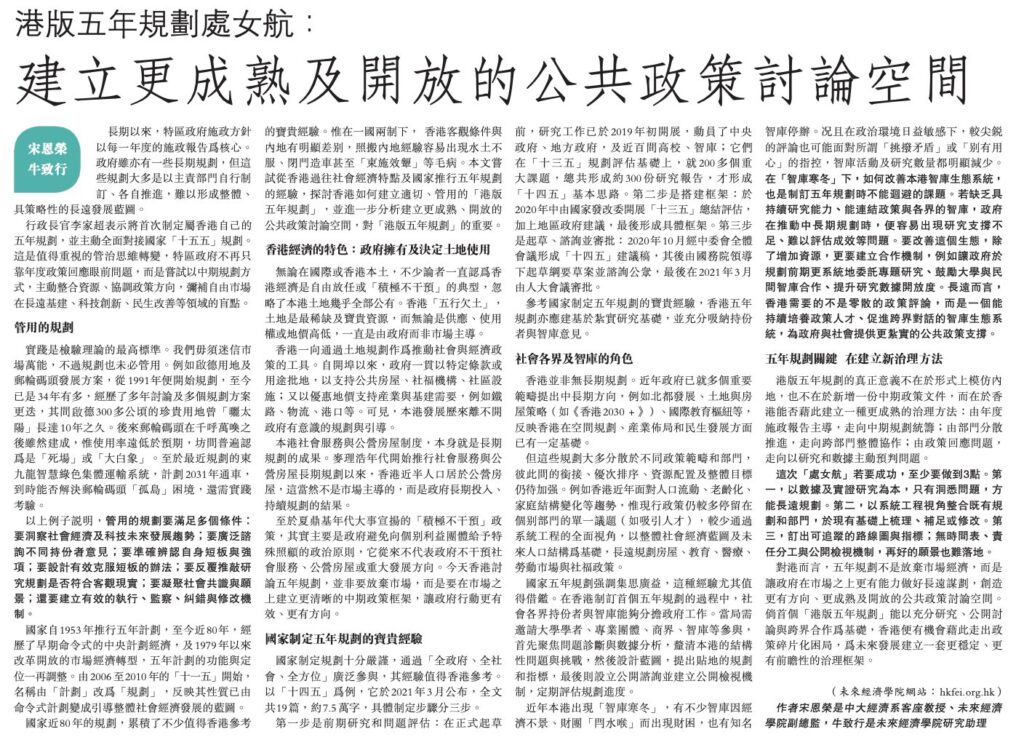
We examine the significance of Hong Kong’s first “Five-Year Plan,” arguing that it represents a shift in governance from an annual Policy Address driven approach to medium-term strategic coordination. The article also highlights the need for Hong Kong to integrate existing plans more effectively through data-driven, systems-based policymaking, while fostering a more mature and open public policy discourse and a stronger think tank ecosystem.
- 港版五年規劃處女航:建立更成熟及開放的公共政策討論空間 by Yun-wing Sung, Alex Ngau
January 2026 | Public Housing Assistance
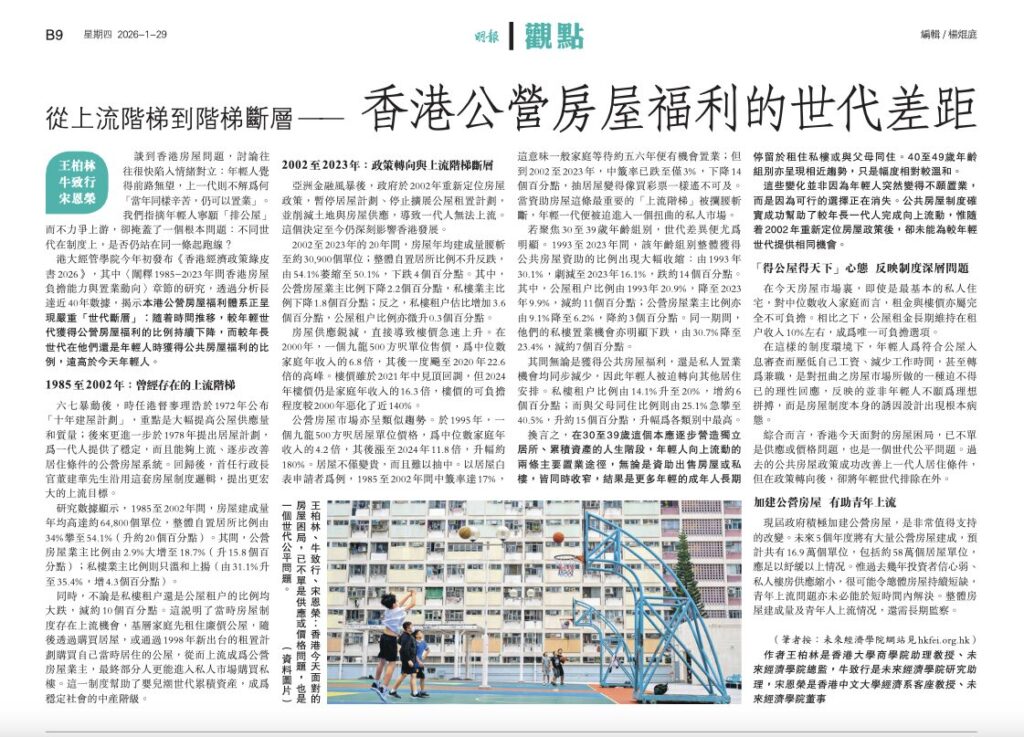
Hong Kong’s public housing welfare system is showing a serious intergenerational divide: younger cohorts are increasingly less likely to receive public housing support, based on our analysis of General Household Survey (GHS) data.
- 從上流階梯到階梯斷層—香港公營房屋福利的世代差距 by Michael Wong, Alex Ngau,Yun-wing Sung
November 2025 – January 2026 | Population Policy
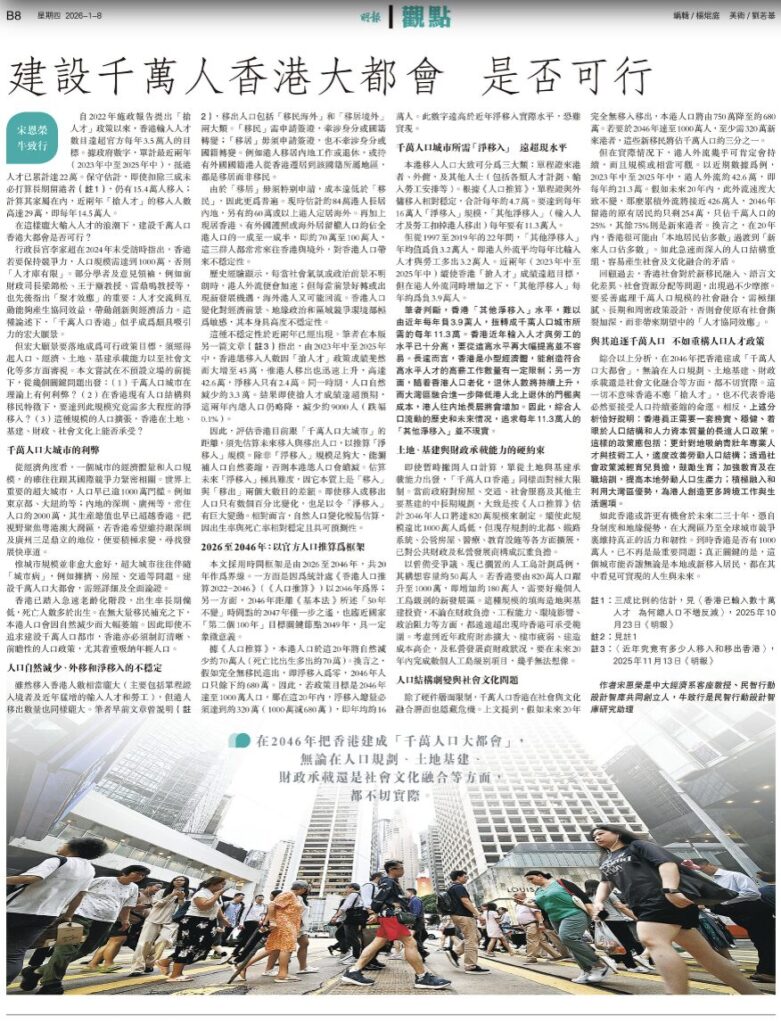
Hong Kong’s population trends and long-term planning challenges are analyzed using data and projections. An increasingly mobile population requires major policy adjustments.
- 建設千萬人香港大都會是否可行? by Yun-wing Sung, Alex Ngau
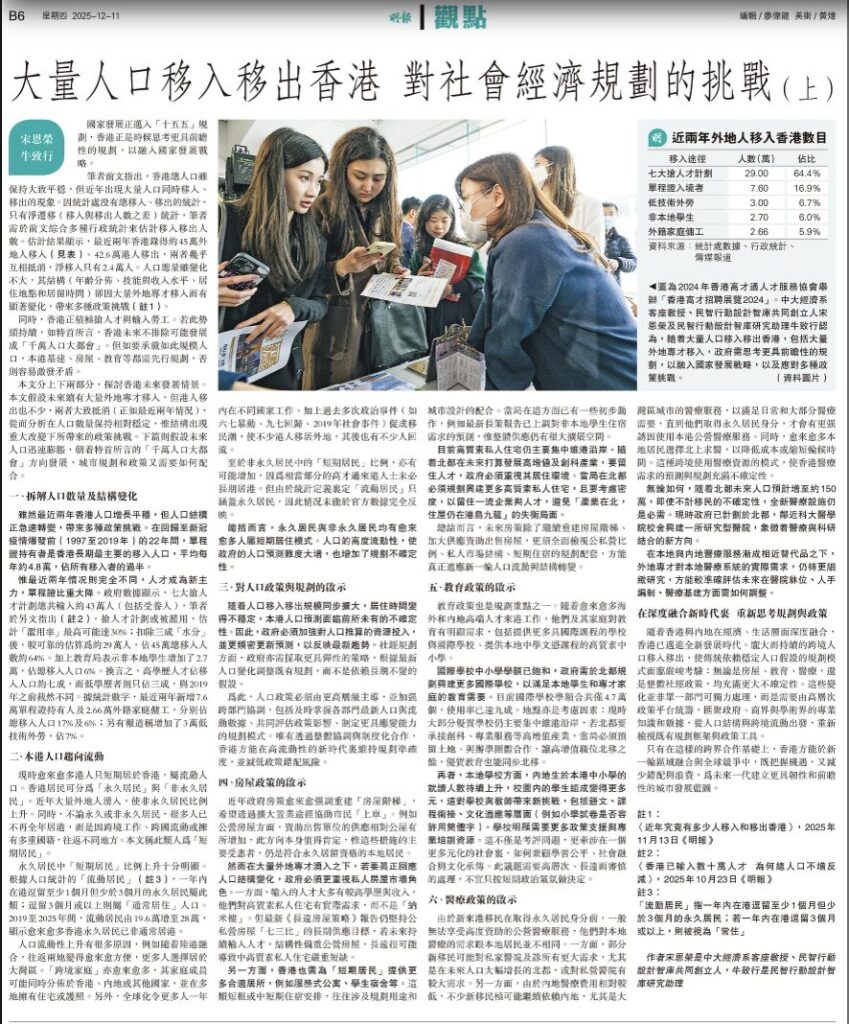
- 大量人口移入移出香港 對社會經濟規劃的挑戰(上)by Yun-wing Sung, Alex Ngau
- 香港已輸入數十萬人才 為何總人口不增反減 by Yun-wing Sung
October 2025 | Policy Address 2025
The effectiveness of the new housing policy measures in the 2025 Policy Address is analyzed, with empirical data and new projections. Increases in public housing unit circulation are a step in the right direction, but need to be deepened.
- 施政報告2025 扶助置業方向正確 可惜力度不足 by Michael Wong, Alex Ngau, Yun-wing Sung
September 2025 | Pathway to Increasing Homeownership
Expanding subsidized homeownership and ensuring sufficient housing supply should be prioritized as key public policy reforms in Hong Kong.
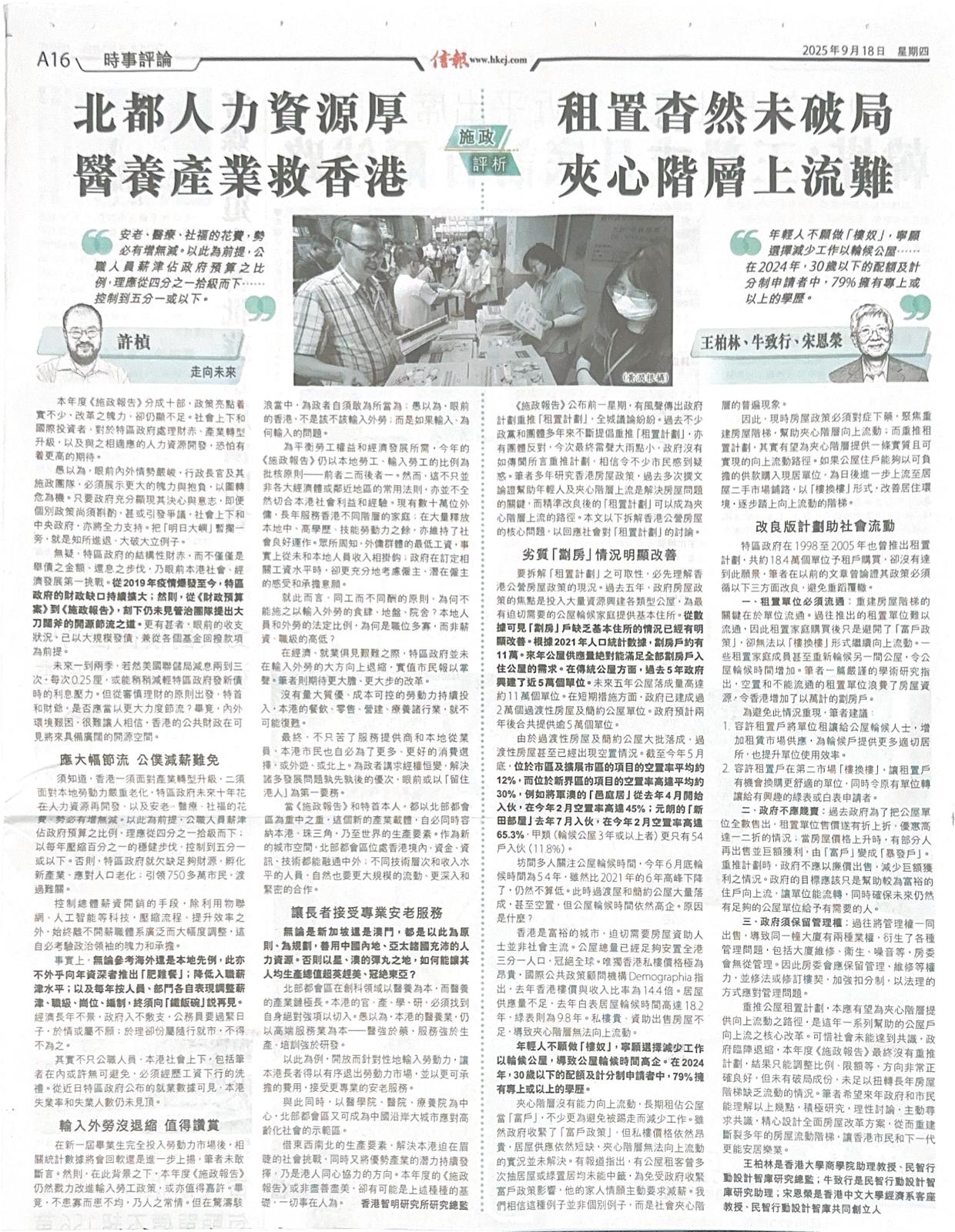
- 租置杳然未破局 夾心階層上流難 by Michael Wong, Alex Ngau, Yun-wing Sung
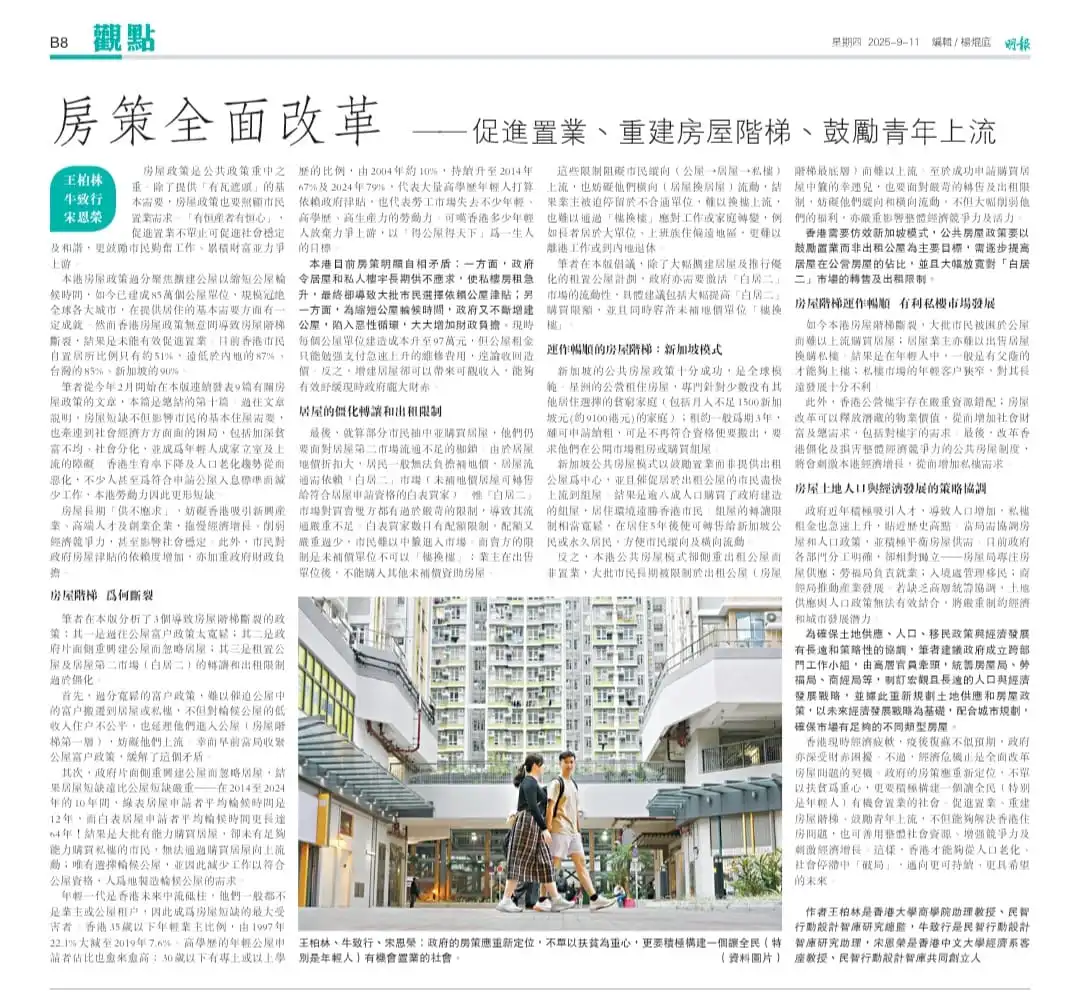
- 房屋政策全面改革 :促進置業、重建房屋階梯、鼓勵青年上流 by Michael Wong, Alex Ngau, Yun-wing Sung
August 2025 | Policy Address 2025
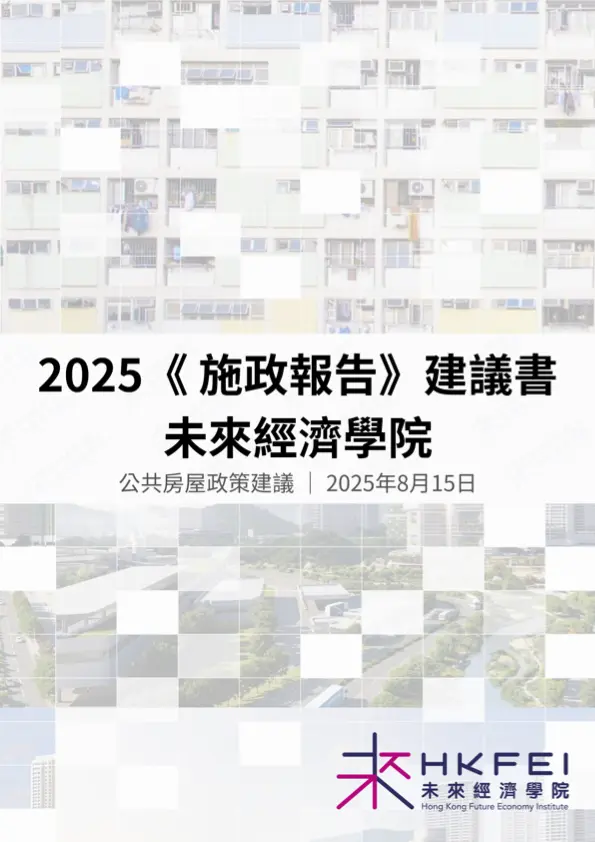
HKFEI’s 2025 Policy Address Consultation Paper has been submitted. Housing reform is highlighted as key to Hong Kong’s future using quantitative evidence and economic analysis. Lessons from failed past reforms are discussed. Detailed recommendations for reform steps and timeline are provided.
- 2025施政報告建議書 | 15 August
June – August 2025 | Pathway to Increasing Homeownership
Reforms to public housing construction ratios and Home Ownership Scheme Secondary Market (HOSSM) regulations are proposed based on economic analysis of empirical evidence.
- 公營房屋改革 會否沖跨私樓市場? by Michael Wong, Alex Ngau, Yun-wing Sung
- 租置計劃:從失敗教訓到全民共享? by Michael Wong, Alex Ngau, Yun-wing Sung
- 居屋嚴重短缺扭曲社會發展 需大幅擴建 by Michael Wong, Alex Ngau, Yun-wing Sung
- 居屋二手市場流通窒息 買賣限制須大幅放寬 by Michael Wong, Alex Ngau, Yun-wing Sung
June 2025 | Cash Allowance Trial Scheme
The government’s cancellation of the Cash Allowance Trial Scheme is supported in our new article. A theoretical framework to inform the design of housing subsidy policy is also provided.
- 現金津貼試行計劃退場 是明智決定——從經濟學理論看補貼轉型的必要性 by Michael Wong, Alex Ngau, Yun-wing Sung
April 2025 | Tenants Purchase Scheme Relaunch Blueprint
A greater emphasis on subsidized homeownership over subsidized rental schemes is needed to address Hong Kong’s fiscal challenges. A strategic shift in Hong Kong’s housing policy towards homeownership subsidies is proposed.
- 財赤之出路:賣公屋 救香港 by Michael Wong, Alex Ngau, Yun-wing Sung
- How Hong Kong can reimagine its greatest asset: people’s homes by Michael Wong, Alex Ngau
March 2025 | Well-off Tenants Policy Reform
The passage of the Well-off Tenants Policy (WTP) reform is celebrated. The WTP reform adopts policy changes that we have forcefully advocated, including the use of rent-to-income ratio as a benchmark for evaluating WTP fairness. We now propose continued use of this benchmark to update WTP policy in future years.
- 公屋富戶政策改革 是改善民生一大步 by Michael Wong, Alex Ngau, Yun-wing Sung
February – March 2025 | Housing Reform Blueprint
Comprehensive housing reform is the key to addressing many of Hong Kong’s socioeconomic problems.
- 香港經濟面臨長期衰退 房策須全面改革 (上) by Michael Wong, Alex Ngau, Yun-wing Sung
- 香港經濟面臨長期衰退 房策須全面改革 (下) by Michael Wong, Alex Ngau, Yun-wing Sung
January 2025 | Economic Recession Crisis
The economic recession crisis in Hong Kong since 2019 is discussed. Talent and population policy are argued to be crucial role for Hong Kong’s future.
- 香港經濟的漫漫長夜有否黎明? (上) by Yun-wing Sung
- 香港經濟的漫漫長夜有否黎明? (下) by Yun-wing Sung
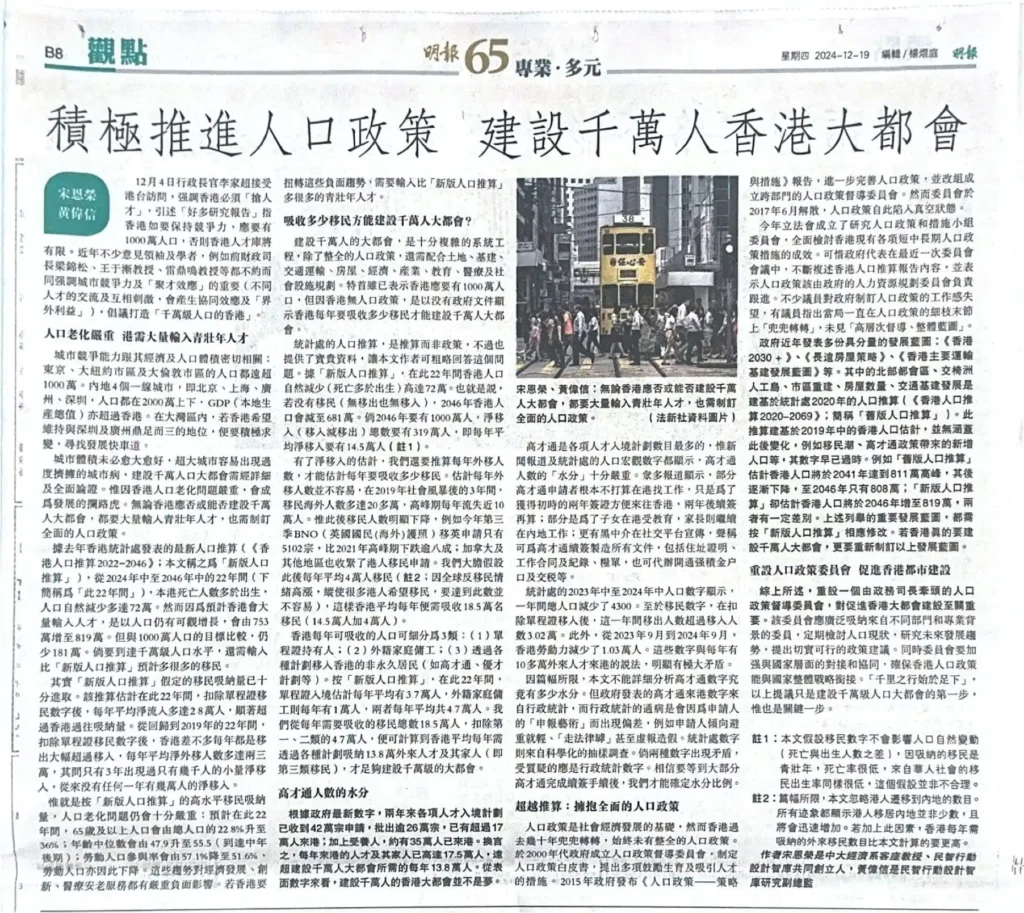
December 2024 | Population Policy
The government’s vision of developing Hong Kong into a metropolis capable of sustaining a population of 10 million people is supported. A thorough analysis of the challenges involved is provided. The establishment of a Population Policy Strategy Committee to formulate and oversee a sustainable roadmap is recommended.
- 積極推進人口政策 建設千萬人香港大都會 by Yun-wing Sung and Wilson Wong
December 2024 | Well-off Tenants Policy Reform
Housing Secretary Winnie Ho’s proposed reform to the Well-off Tenants Policy is forcefully supported by our latest article. The reform rectities a long-standing problem and should be enthusiastically adopted.
- 富戶租金嚴重過低 必須調整 by Michael Wong, Jimmy Ho, Alex Ngau
November 2024 | Subdivided Housing Crisis
The government’s decision not to implement initial rent control for subdivided units is supported. Empirical evidence and international policy experience suggest that initial rent control risks creating a permanent underclass. Alternative policies can address the subdivided housing crisis without distorting market mechanisms.
- 要告別劏房 絕不能規管起始租金 by Michael Wong, Yun-wing Sung
September – October 2024 | Strategies for Fundamental Reform
The importance and strategies needed for fundamental reforms in Hong Kong are analyzed in our latest articles.
- 從「50年不變」到「識變、應變、求變」(上篇) by Yun-wing Sung
- 從「50年不變」到「識變、應變、求變」(中篇) by Yun-wing Sung
- 從「50年不變」到「識變、應變、求變」(下篇) by Yun-wing Sung
September 2024 | Policy Address 2024
HKFEI’s 2024 Policy Address Consultation Paper has been submitted. Innovative policy frameworks and actionable recommendations across key policy domains are proposed, including housing supply, population planning, strengthened policy research and data science capabilities, support mechanisms for the reintegration of arrested youth, and sustainable healthcare reforms.
- 2024施政報告建議書
August 2024 | Pathway to Increasing Homeownership
The shortage of affordable housing is shown to undermine Hong Kong’s efforts to attract talent. The Government is urged to prioritise and implement comprehensive housing and urban planning reforms.
- 住房短缺礙引才 政府應續增建屋 by Michael Wong
- Hong Kong’s economic recovery hinges on having enough adequate housing by Michael Wong
February – May 2024 | Well-off Tenants Policy Reform
The Well-off Tenants Policy is shown to require fundamental reform. Population statistics demonstrate that public rental housing units are significantly misallocated to well-off tenants, thereby exacerbating the subdivided housing crisis.
- 加強富戶審查 劏房戶免受苦?by Michael Wong, Jimmy Ho
- Hong Kong must stop letting the well-off hog public rental housing by Michael Wong, Jimmy Ho
- 香港劏房問題之出路 by Michael Wong