December 6, 2024 · 《Ming Pao》
In this year’s Policy Address, Chief Executive John Lee announced a tightening of the well-off tenant policy for public rental housing. Secretary for Housing Winnie Ho has proposed that tenants whose income exceeds the income limit by two to three times should pay double rent; those exceeding the limit by three to four times should pay triple rent; and those exceeding the limit by four times must vacate their public housing units. Some members of the Housing Authority, however, have expressed reservations, fearing that this reform will cause well-off tenants to move down the housing ladder.
However, the “well-off tenants downgrading” theory circulating in the community lacks supporting data. Drawing on the authors’ many years of experience researching Hong Kong’s housing policy, in-depth analysis of population census data, and a comparison of housing policies between Hong Kong and other regions, this article examines the impact of the Housing Authority’s well-off tenant policy tightening on public housing residents, and argues whether Housing Authority members should accept the government’s proposed revisions to the well-off tenant policy.
1. The ‘Well-off Tenants Downgrading’ Theory Has No Empirical Basis and Is Entirely Unfounded
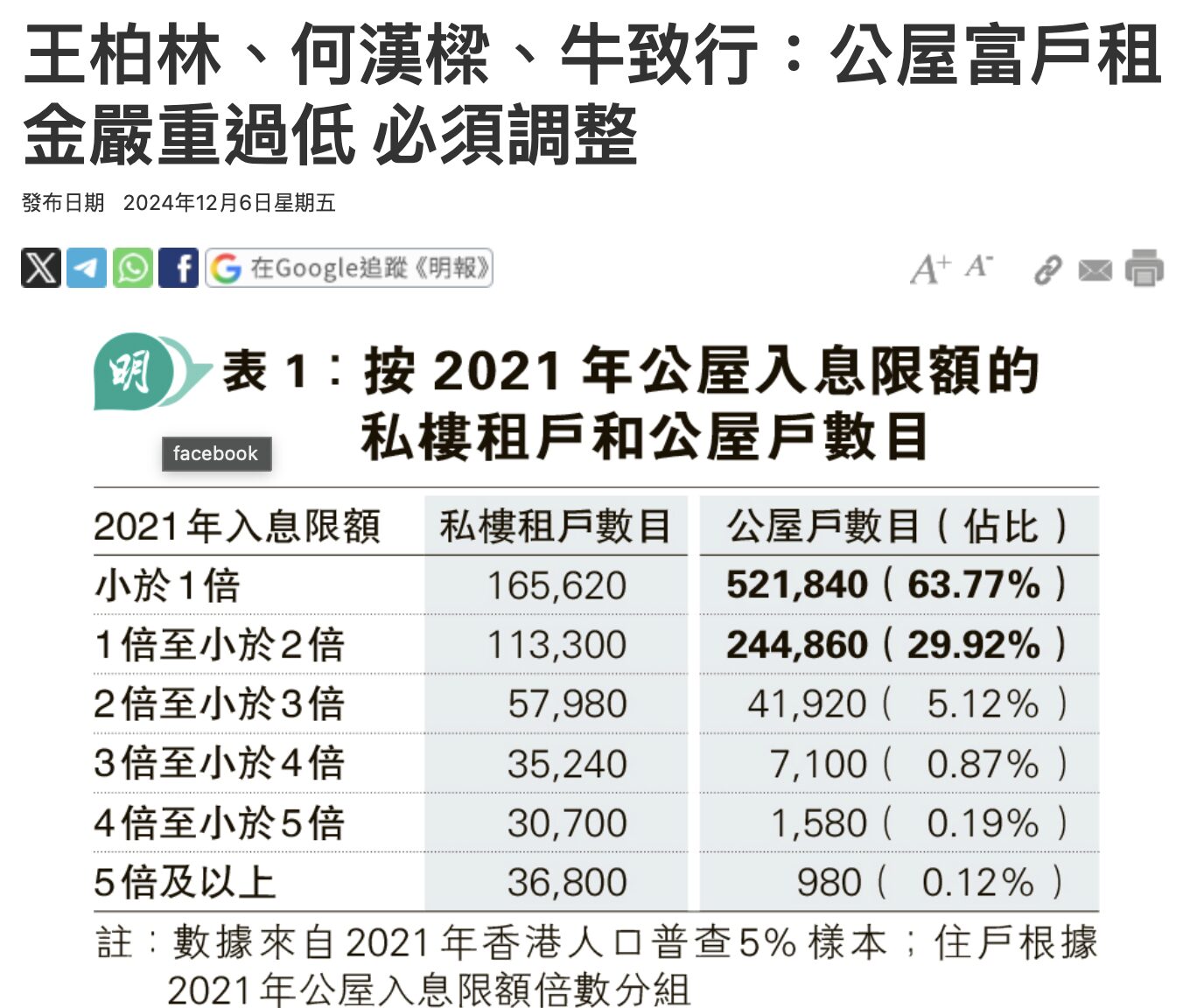
First, data analysis shows that Secretary Ho’s proposal would affect only a small number of high-income public housing tenants. According to 2021 population census data, tenants with income at or below twice the public housing income limit account for 94% of all public housing tenants. The well-off tenants whose income exceeds twice the income limit are few, accounting for only 6% of public housing households — roughly 50,000 families. These families all sit at or above the 70th percentile of Hong Kong’s population income distribution. “Super well-off” tenants whose income exceeds four times the income limit are at or above the 92nd percentile of the population income distribution. Tightening the well-off tenant policy therefore affects only households at the very top of the income pyramid, while those genuinely in need of subsidy will not lose their public housing eligibility as a result.
Second, under the current policy, the rent paid by public housing tenants whose income exceeds twice the income limit is very low, accounting for only a tiny portion of their household income. Take a three-person family as an example: the current public housing income limit is HK$24,740. If a household’s income exceeds the limit by three to five times — i.e. around HK$100,000 per month — it only needs to pay double the net rent. The public housing rent ceiling is HK$2,810, so even at double it is only HK$5,620. Moreover, according to population census data, public housing rent accounts for only 4% to 5% of these households’ income. By contrast, families of similar household size whose income is below the limit must pay at least 16% of their income as rent.
The government’s proposal would not substantially increase the burden on these households. If a public housing tenant with income exceeding the limit by two to three times is required to pay double rent, the adjusted rent would still account for only 7.9% of their total household income. If a tenant with income exceeding the limit by three to four times is required to pay triple rent, the adjusted rent would still account for only 6.6% of their total household income.
This change would only slightly raise the rent-to-income ratio of well-off tenants, bringing it closer to the ratio faced by non-well-off tenants. The United Nations considers housing expenditure affordable up to 30% of income. Even if the SAR government raises well-off tenants’ rent slightly to between 6% and 8% of their income, it would still be only a small share of their income — well within the affordable range.
Third, tenants who are required to leave would be fully capable of affording market rent. As Table 3 shows, for tenants whose income exceeds the limit by two times, the equivalent market rent would on average account for only 28% or less of their income; for tenants whose income exceeds the limit by four times, the ratio would be even lower — on average no more than 24% of their income. These ratios remain below the United Nations’ affordability standard of rent not exceeding 30% of income.
The above data demonstrate that the proposed revision would only require “super well-off” tenants with monthly income of roughly HK$100,000 or more to move out. People with such income capacity would not be forced to move down the housing ladder as a result.
2. Compared to Overseas Standards, Hong Kong’s Well-off Tenant Policy Is Clearly Too Lenient
According to general principles of political ethics, social welfare policy under conditions of limited resources should prioritise the disadvantaged, and those with greater capacity should bear more, in order to achieve a fair distribution of social resources. Hong Kong’s situation is the very opposite — rent on average accounts for 3% to 5% of well-off tenant households’ total income, but about 16% for non-well-off households (Table 3). This kind of rent policy is highly regressive.
Countries have different policies reflecting their own national circumstances; rent-to-income ratios are mostly set between 15% and 30%. In particular, when it comes to well-off tenants whose income exceeds the limit, the standard approach is to charge rent equivalent to the market price or to require tenants to move out, so as to balance the public interest and the impact on well-off tenants.
Looking around the world, in Europe and the United States — including the United Kingdom and the United States — public housing tenants’ average rent accounts for 27% and 30% of income respectively. In the United States, if a household’s income exceeds the limit for two consecutive years, it must pay higher rent or move out. The United Kingdom has no central policy specifically targeting well-off tenants; according to the 2021/22 housing census, more than 12% of well-off tenants with income above the median live in public housing (social housing).
In Asia, taking Mainland China as an example, public rental housing rents are set by local governments according to specific circumstances. The two major cities in Guangdong Province — Guangzhou and Shenzhen — both have public rental housing and both have well-off tenant policies. In Guangzhou, if a tenant’s income exceeds the limit but by less than 1.5 times, they must pay rent equivalent to 20% or more of their monthly income; tenants whose income exceeds the limit by 3 times must move out within a six-month transition period.
In Shenzhen, if a tenant’s income exceeds the limit but their household per-capita annual disposable income does not exceed the previous year’s average income of working households in Shenzhen, the rent is set at double the original rate. If income exceeds that benchmark, the government grants tenants a three-year transition period to relocate, with rent set at 60% of market rent; for those facing difficulties, after the transition period expires rent is calculated at the market rate.
Singapore’s public rental housing is reserved for a small number of poor families with no other housing options. For example, for a household with a monthly income of SGD 600 (about HK$3,500), the rent-to-income ratio is around 5% to 9%; for households with monthly income between SGD 800 and SGD 1,500 (about HK$4,600 to HK$8,700), the ratio is between 10% and 15%. For higher-income tenants, the Singapore government typically requires them to rent on the open market or to purchase an HDB flat. In recent years, Singapore has removed the income cap and adopted a case-by-case assessment model, flexibly providing short-term housing to families most in need.
Taipei’s social housing rent is set at 80% to 85% of the market rate, similarly tiered by income, with rent reductions granted to families in need. For a three-person two-bedroom unit, the average rent for the lowest-income tier is more than 18% of income; the second tier is 13% to 19%; the third tier is 11% to 14%; and the highest tier is 13% to 15%. Because social housing is intended for short-term housing needs, income and asset reviews are only conducted at lease renewal. A standard lease runs for three years, and ordinary families may renew once at most — meaning a maximum stay of six years.
It is therefore clear that even after Hong Kong tightens its well-off tenant policy, its well-off tenant policy would still be far more lenient than those of the places mentioned above.
Well-off tenants have long occupied public housing units and received substantial rent subsidies from the government. This is clearly a misallocation of public housing resources, harmful to the public interest, and especially unfair and disadvantageous to the low-income households waiting for public housing. As noted above, welfare policy should help the disadvantaged — not tilt in favour of tenants who are able to afford higher rent.
3. Tightening the Well-off Tenant Policy Will Help Reduce Public Rental Housing Wait Times
The existing well-off tenant policy is not only grossly unfair to those waiting for public housing and to tenants in the private sector, it also gives rise to a range of social problems. The authors’ prior research has shown that one of the reasons for the surge in subdivided flats between 2006 and 2021 was that the well-off tenant policy was too lax.1
According to the latest figures, the average public housing waiting time is 5.5 years, with around 122,000 general applications. Although the waiting time has already come down from its 2022 peak of an average 6.1 years, this is still no short stretch for low-income households. In this year’s Policy Address, Chief Executive John Lee set out the aspiration of bringing it down to 4.5 years by 2026/27.
Many of the low-income households currently waiting for public housing live in subdivided flats, in cramped and poor living conditions. According to the 2021 population census, about 2% of Hong Kong’s population lives in rooms smaller than 130 square feet — smaller than a parking space. People living in such spaces for prolonged periods are prone to physical or psychological problems. The government has put forward the concept of “simple and modest rooms” in the Policy Address to improve the subdivided flat environment, but the root cause of the problem is the shortage of public housing units.
To address this, the government has implemented measures including the construction of transitional housing and Light Public Housing, as well as tightening the well-off tenant policy. The first two aim to provide additional short-term housing for those on the public housing waiting list; the latter aims to encourage existing tenants to vacate their units. The authors believe that only by tackling both fronts can the problem be improved as quickly as possible, ensuring that public housing resources are allocated effectively and that those truly in need benefit.
If the government can require “super well-off” tenants whose income exceeds the limit by four times to move out of public housing, and encourage well-off tenants whose income exceeds the limit by two to four times to move, this would free up public housing units and shorten the current long waiting time. It would also give subdivided-flat families — who have waited endlessly on the register and endured high rents — a reasonable, affordable home, significantly improving their rental living environment and fulfilling their dream of having a place to live.
4. Conclusion
Xia Baolong, Director of the Hong Kong and Macao Affairs Office, has instructed that Hong Kong must resolve its housing problems — particularly the subdivided flat problem — as soon as possible. The fact that the SAR government has for many years allowed high-income public housing tenants to occupy valuable public housing resources at extremely low rents is one of the main causes of the proliferation of subdivided flats, and this policy must therefore be reformed. The data show that the government’s proposed well-off tenant reform is reasonable and desirable: it balances the public interest and the impact on well-off tenants without affecting the vast majority of public housing families. Housing Authority members need not worry about well-off tenants “moving down the ladder”, and they certainly should not, under political pressure, defend the interests of a small number of well-off tenants — thereby holding up housing reform and obstructing the vital task of eradicating subdivided flats.
(Translation supported by AI)