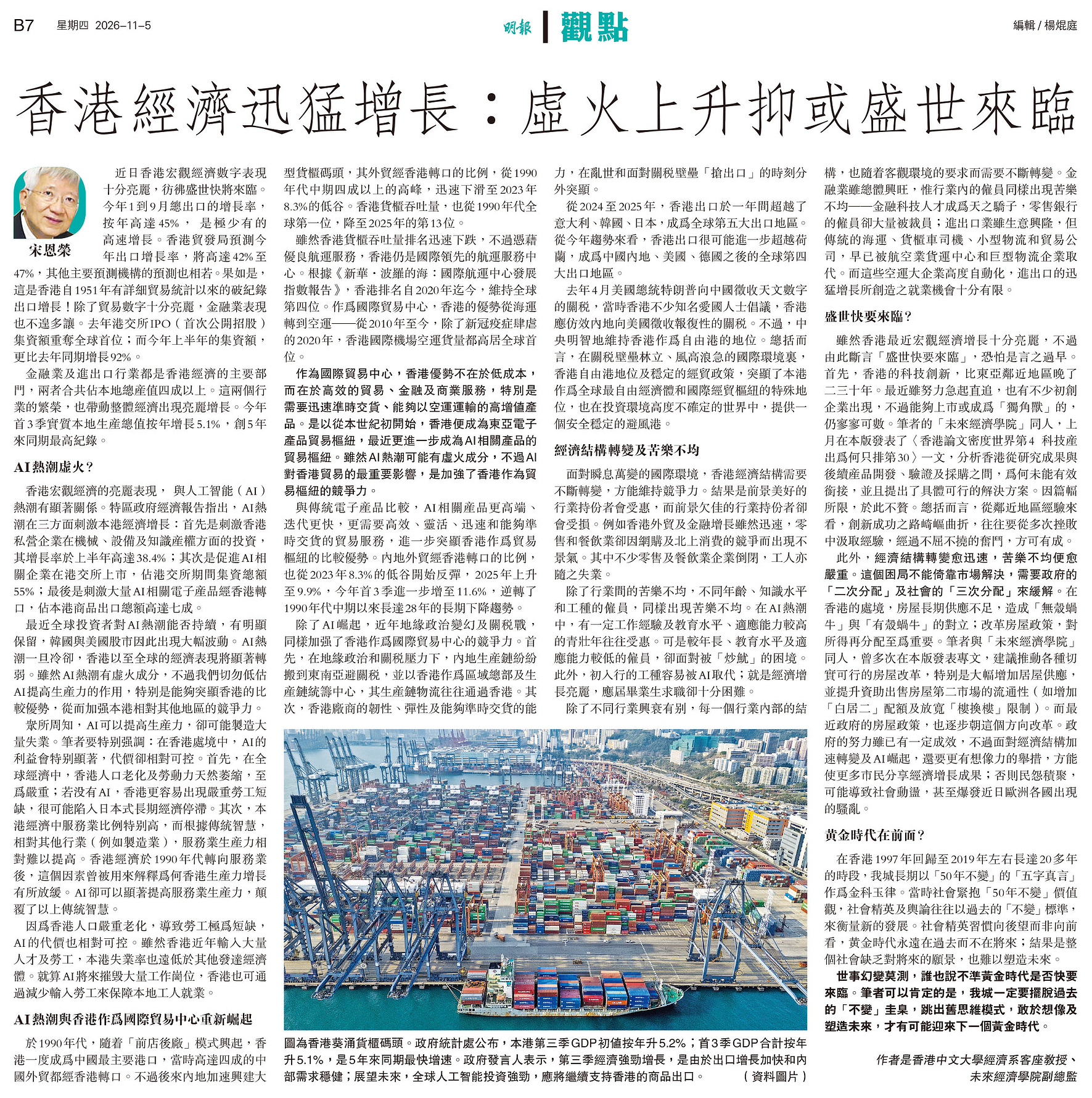
Hong Kong’s recent macroeconomic figures have been exceptionally strong, giving the impression that a new era of prosperity may be just around the corner. In the first nine months of this year, total exports grew by 45% year on year—an unusually rapid pace. The Hong Kong Trade Development Council forecasts export growth of between 42% and 47% for the full year, with other major forecasters offering similar projections. If these forecasts materialise, Hong Kong will record its fastest export growth since detailed trade statistics began in 1951. The financial sector has been no less impressive. Last year, Hong Kong Exchanges and Clearing regained the top global ranking for funds raised through initial public offerings (IPOs). In the first half of this year, IPO proceeds rose a further 92% compared with the same period last year.
Finance and import-export trade are both major pillars of Hong Kong’s economy, together accounting for more than 40% of GDP. Their strong performance has also driven robust growth across the economy. Real GDP grew by 5.1% year on year in the first three quarters, the strongest growth for the period in five years.
Is the AI boom overheating?
Hong Kong’s strong macroeconomic performance is closely linked to the artificial intelligence (AI) boom. The Hong Kong Government’s economic report identifies three channels through which AI has stimulated growth. First, it has boosted private-sector investment in machinery, equipment and intellectual property products, which grew by 38.4% in the first half of the year. Second, it has encouraged AI-related companies to list in Hong Kong, accounting for 55% of total funds raised on the exchange during the period. Third, it has driven substantial re-exports of AI-related electronic products through Hong Kong, accounting for as much as 70% of the city’s total merchandise exports.
Global investors have recently shown clear reservations about whether the AI boom can be sustained, contributing to sharp fluctuations in South Korean and US stock markets. If the boom cools, economic performance in Hong Kong and around the world will weaken considerably. Although the AI boom contains elements of speculative excess, we should not underestimate AI’s ability to raise productivity, particularly by bringing Hong Kong’s comparative advantages into sharper focus and strengthening its competitiveness relative to other economies.
It is widely recognised that AI can increase productivity but may also cause substantial unemployment. I wish to emphasise that, in Hong Kong’s particular circumstances, the benefits of AI are likely to be especially significant, while the costs should be relatively manageable. First, Hong Kong faces some of the most severe population ageing and natural labour-force decline in the global economy. Without AI, the city would be more vulnerable to serious labour shortages and could well fall into prolonged economic stagnation of the kind experienced by Japan. Second, services account for an exceptionally large share of Hong Kong’s economy. Conventional wisdom holds that productivity is harder to improve in services than in other sectors, such as manufacturing. After Hong Kong shifted towards a service-based economy in the 1990s, this was cited as one explanation for its slowing productivity growth. AI, however, can substantially increase productivity in services, overturning that conventional wisdom.
The severe labour shortages caused by Hong Kong’s ageing population also make the costs of AI relatively manageable. Even though Hong Kong has admitted large numbers of talent and workers in recent years, its unemployment rate remains far below those of other advanced economies. Even if AI eventually eliminates large numbers of jobs, Hong Kong could protect local employment by reducing the number of imported workers.
The AI boom and Hong Kong’s resurgence as an international trading centre
In the 1990s, as the “front shop, back factory” model took hold—with Hong Kong handling commercial functions and mainland China undertaking production—Hong Kong became China’s leading port for a time. As much as 40% of China’s foreign trade was then re-exported through the city. As the mainland subsequently accelerated the construction of large container terminals, however, the share of its foreign trade re-exported through Hong Kong fell rapidly from a peak of more than 40% in the mid-1990s to a low of 8.3% in 2023. Hong Kong’s global ranking for container throughput also dropped from first place in the 1990s to 13th in 2025.
Despite the sharp fall in its container-throughput ranking, Hong Kong remains a leading international maritime services centre thanks to the quality of its shipping services. According to the Xinhua–Baltic International Shipping Centre Development Index, Hong Kong has maintained fourth place globally since 2020. Its strengths as an international trading centre have shifted from sea freight to air freight: since 2010, Hong Kong International Airport has ranked first globally for cargo throughput every year except 2020, when the COVID-19 pandemic was at its height.
Hong Kong’s advantage as an international trading centre lies in efficient trade, financial and business services rather than low costs. These strengths are particularly valuable for high-value-added products that can be transported by air and require fast, punctual delivery. Since the early years of this century, Hong Kong has consequently become an East Asian hub for trade in electronic products and, more recently, a hub for AI-related products. Although the AI boom may contain elements of speculative excess, its most important effect on Hong Kong’s trade is to strengthen the city’s competitiveness as a trading hub.
Compared with traditional electronic products, AI-related products are more sophisticated and evolve more rapidly. They therefore require trading services that are even more efficient, flexible, fast and reliable in meeting delivery deadlines, further highlighting Hong Kong’s comparative advantage as a trading hub. The share of mainland China’s foreign trade re-exported through Hong Kong has also rebounded from its low of 8.3% in 2023, rising to 9.9% in 2025 and then to 11.6% in the first three quarters of this year. This has reversed a 28-year downward trend that began in the mid-1990s.
Alongside the rise of AI, geopolitical shifts and tariff wars in recent years have also strengthened Hong Kong’s competitiveness as an international trading centre. First, under geopolitical and tariff pressures, mainland production chains have been relocating to Southeast Asia to avoid tariffs, while using Hong Kong as a regional headquarters and a centre for coordinating production chains. The logistics flows supporting these production chains often pass through Hong Kong. Second, Hong Kong manufacturers’ resilience, flexibility and ability to deliver on time become particularly valuable in turbulent conditions and when exporters rush to ship goods ahead of tariff barriers.
Between 2024 and 2025, Hong Kong overtook Italy, South Korea and Japan within a single year to become the world’s fifth-largest exporting economy. Judging by this year’s trends, it may well overtake the Netherlands to become the fourth-largest, behind mainland China, the United States and Germany.
When US President Donald Trump imposed extraordinarily high tariffs on China in April last year, a number of prominent patriotic figures in Hong Kong advocated following the mainland’s example by imposing retaliatory tariffs on the United States. The central government, however, wisely maintained Hong Kong’s free-port status. In an international environment marked by proliferating tariff barriers and considerable turbulence, Hong Kong’s free-port status and stable trade and economic policies highlight its distinctive position as the world’s freest economy and an international trade and economic hub. They also offer a safe and stable haven in a world of profound investment uncertainty.
Structural economic change and uneven fortunes
To remain competitive in a rapidly changing international environment, Hong Kong must continually adapt the structure of its economy. As a result, stakeholders in sectors with promising prospects benefit, while those in sectors with weaker prospects lose out. For example, while Hong Kong’s foreign trade and financial sector have grown rapidly, retail and catering have struggled with competition from online shopping and spending across the border on the mainland. Many businesses in these sectors have closed, leaving their workers unemployed.
These uneven fortunes extend beyond differences between industries to employees of different ages, educational backgrounds and occupations. During the AI boom, younger and middle-aged adults with some work experience, a certain level of education and greater adaptability often benefit. Older employees with less education and lower adaptability, however, face the prospect of losing their jobs. Entry-level roles are also particularly vulnerable to replacement by AI. Even amid strong economic growth, fresh graduates are finding it very difficult to secure employment.
Structural adjustment is also required within each industry as circumstances change. Although finance is thriving overall, fortunes vary considerably among its employees: fintech professionals are highly sought after, while large numbers of retail banking employees are being laid off. Likewise, although import-export trade is booming, traditional sea-freight operations, container-truck drivers, and small logistics and trading companies have long since been displaced by air cargo hubs and large logistics enterprises. These large air cargo businesses are highly automated, so rapid growth in imports and exports creates only a limited number of jobs.
Is a new era of prosperity just around the corner?
Although Hong Kong’s recent macroeconomic growth has been impressive, it would be premature to conclude that a new era of prosperity is imminent. First, Hong Kong began developing technological innovation two or three decades later than its East Asian neighbours. Although it has recently worked hard to catch up and numerous start-ups have emerged, very few have gone public or become unicorns. Last month, my colleagues at the Hong Kong Future Economy Institute published an article on these pages entitled “Hong Kong Ranks Fourth Worldwide in Research Paper Density—Why Only 30th in Technological Output?” It examined why Hong Kong has struggled to connect research findings with subsequent product development, validation and procurement, and proposed practical solutions. Space does not permit a further discussion here. The experience of neighbouring economies shows that successful innovation is a difficult and winding journey, often requiring lessons to be learned from repeated setbacks and sustained perseverance before results can be achieved.
Moreover, the faster structural economic change proceeds, the more uneven its benefits and costs become. This problem cannot be resolved by the market alone. It requires government-led “secondary distribution” through taxation and public spending, as well as society’s “tertiary distribution” through charitable and philanthropic efforts. In Hong Kong, a persistent shortage of housing has created a divide between those who own their homes and those who do not. Housing policy reform is therefore particularly important for income redistribution. Together with my colleagues at the Hong Kong Future Economy Institute, I have repeatedly published articles on these pages proposing practical housing reforms. These include substantially increasing the supply of Home Ownership Scheme flats and improving liquidity in the secondary market for subsidised sale flats, for example by increasing quotas under the White Form Secondary Market Scheme and relaxing restrictions on owners selling one subsidised flat to buy another. Recent government housing policies have also gradually moved in this direction. Although these efforts have achieved some results, more imaginative measures are needed in response to accelerating structural change and the rise of AI if more residents are to share in the benefits of economic growth. Otherwise, accumulating public discontent could lead to social unrest, or even riots of the kind recently seen across Europe.
Does Hong Kong’s golden age lie ahead?
For more than two decades, from Hong Kong’s return to Chinese sovereignty in 1997 until around 2019, the city treated the five Chinese characters meaning “unchanged for 50 years” as an inviolable guiding principle. Society held tightly to the value of remaining unchanged, while elites and public opinion often judged new developments against the standards of an unchanging past. The city’s elites became accustomed to looking backwards rather than forwards: the golden age was always in the past, never in the future. As a result, society as a whole lacked a vision for the future and struggled to shape it.
In an unpredictable and ever-changing world, no one can say for certain whether a golden age is just around the corner. What I can say with confidence is that Hong Kong must move beyond its past attachment to remaining unchanged, break out of old patterns of thought, and dare to imagine and shape its future. Only then can the city hope to usher in its next golden age.
(Translation supported by AI)