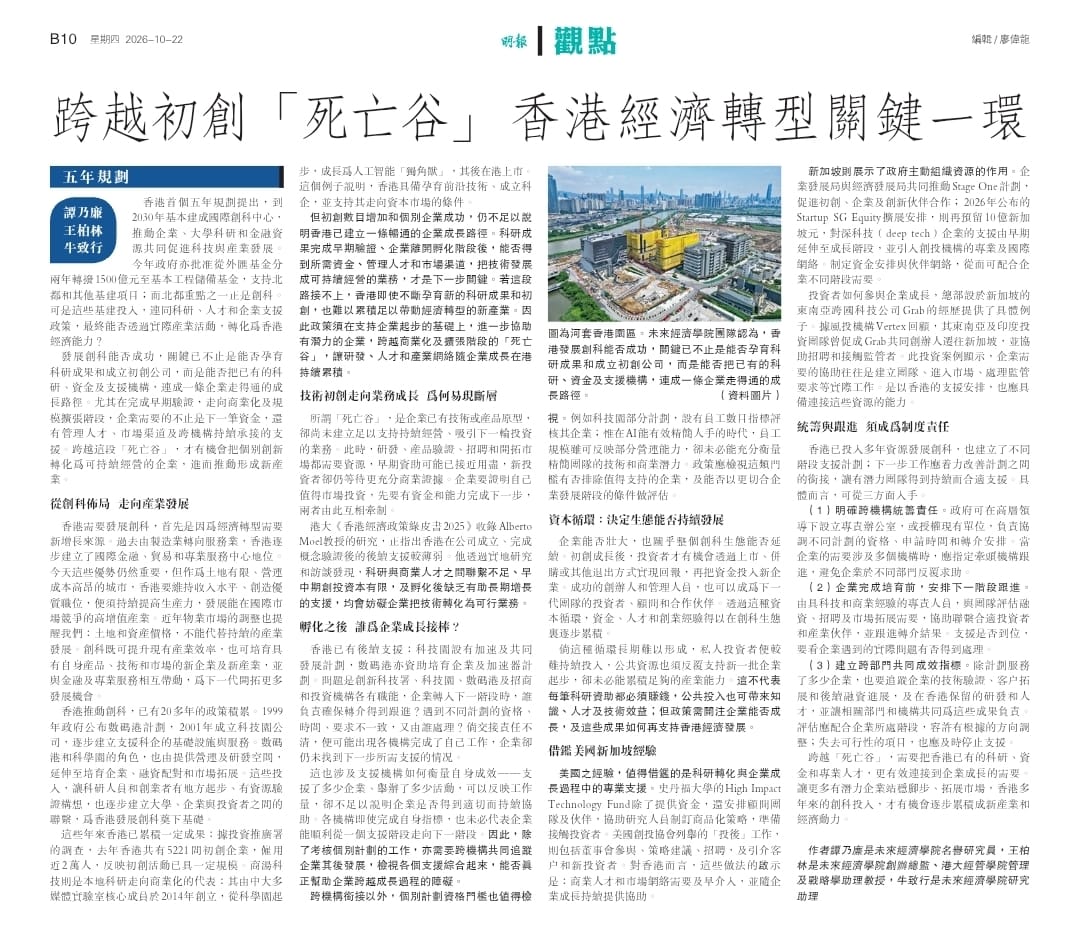
Abstract: Hong Kong’s First Five-Year Plan (《香港第一個五年規劃》) sets out to build the city into an international innovation and technology centre by 2030, bringing business, university research and financial resources together to advance technology and industrial development. This year the Government also approved transferring HK$150 billion from the Exchange Fund into the Capital Works Reserve Fund over two years, to support the Northern Metropolis and other infrastructure projects. Building up an innovation and technology cluster is one of the Northern Metropolis priorities. Whether those infrastructure investments, together with research, talent and business support policies, can be turned into Hong Kong’s economic capability through real industrial activity is the open question.
Success in innovation and technology turns on more than whether Hong Kong can produce research results and start companies. It depends on whether the research capacity, funding and support agencies already in place can be linked into a growth path that companies can actually use. Most of that pressure falls on the stage after early validation, when firms move towards commercialisation and scale. What they need there is more than the next round of funding: management talent, market channels, and support that keeps being carried across agency boundaries. Only by getting across this valley of death can individual innovations turn into sustainable businesses and, in turn, build new industries.
From an I&T footprint to industrial development
Hong Kong needs to develop innovation and technology in the first place because economic transition requires new sources of growth. The shift from manufacturing to services is what built Hong Kong’s position as an international centre for finance, trade and professional services. Those advantages still matter, but in a city with limited land and high operating costs, holding income levels and creating quality jobs means raising productivity continuously and developing high-value industries that can compete internationally. Recent years of adjustment in the property market have shown the same point from another direction: land and asset prices cannot substitute for continuous industrial development. Innovation and technology can make existing industries more efficient. They also produce new companies and new industries with their own products, technology and markets, and they reinforce finance and professional services, opening up more development opportunities for the next generation.
Hong Kong has more than two decades of policy behind its innovation and technology push. The Government announced the Cyberport project in 1999, and the Hong Kong Science and Technology Parks Corporation was set up in 2001. Together they built the infrastructure and services that support technology companies. The role of Cyberport and the Science Park has also widened, from providing workspace and R&D space to incubating companies, matching them with funding and taking them to market. Those investments gave researchers and founders somewhere to start and the resources to test their ideas, and they gradually built the connections between universities, companies and investors on which Hong Kong’s innovation and technology development now rests.
Results have begun to add up. According to an InvestHK survey, Hong Kong had 5,221 start-ups in 2025, employing close to 20,000 people, which shows that start-up activity has reached a certain scale. SenseTime is the local example of research turning into a commercial business. Founded in 2014 by core members of the Multimedia Laboratory at the Chinese University of Hong Kong, it started at the Science Park, grew into an artificial intelligence “unicorn”, and later listed in Hong Kong. The example shows that Hong Kong has the conditions to incubate frontier technology, start technology companies, and support them all the way to the capital market.
Why the move from technical start-up to business growth breaks down
The “valley of death” is the stage where a company has a technology or a working prototype but has not yet built a business capable of sustaining operations or attracting the next round of funding. R&D, product validation, hiring and market development all draw on resources at this point. Earlier funding may be close to exhausted while new investors wait for stronger commercial evidence. To show that it is worth investing in, the company first needs the money and the capability to take the next step, and the two hold each other back.
A study by Professor Alberto Moel, included in the University of Hong Kong’s Hong Kong Economic Policy Green Paper 2025 (《香港經濟政策綠皮書2025》), identifies precisely this gap. Through field research and interviews he found that weak links between research and commercial talent, limited early- and mid-stage venture capital, and a lack of post-incubation support for long-term growth all stand in the way of companies turning technology into viable businesses.
After incubation, who takes the baton?
Hong Kong already has some follow-on support. The Science and Technology Parks runs acceleration and co-development programmes, and Cyberport funds incubation companies and graduates to join accelerators. The difficulty is that the Innovation and Technology Commission, the Science and Technology Parks, Cyberport and the investment-promotion bodies each have their own mandate. When a company moves to the next stage, who makes sure the referrals are followed up? When the eligibility rules, timing or requirements of different programmes do not line up, who handles it? Where hand-over responsibility is unclear, every agency can complete its own task while the company is still without the support it needs for the next step.
This also raises how support agencies measure their own performance. How many companies they supported and how many events they ran say something about workload, but they do not show whether the companies received appropriate and sustained help. Every agency can meet its own targets while companies still fail to move from one stage of support to the next. Assessing individual programmes is therefore not enough. Agencies also need to track where these companies go next, jointly, and to check whether the support taken as a whole clears the obstacles in a company’s growth.
Beyond the hand-over between agencies, the eligibility thresholds in individual programmes deserve review. Some Science and Technology Parks programmes assess a company partly on headcount. In an era when AI can genuinely cut staffing, headcount does reflect some operating capacity, but it does not fully measure the technical and commercial potential of a lean team. Policy should examine whether such thresholds rule out companies that are worth backing, and whether assessment can use conditions that better fit the company’s stage of development.
The capital cycle decides whether the ecosystem can keep going
Whether companies can grow also depends on whether the wider innovation ecosystem can keep turning over. Only once a start-up has grown can investors realise returns through listing, acquisition or other exits, and put that money into new companies. Successful founders and managers can also become investors, advisers and partners to the next generation of teams. Through that capital cycle, money, talent and entrepreneurial experience build up gradually inside the ecosystem.
If the cycle cannot form over the long run, private investors have little reason to keep putting money in, and public resources have to keep propping up each new batch of companies without necessarily building enough industrial capability along the way. That does not mean every research grant has to make money, and public spending can bring knowledge, talent and technological gains. But policy does need to watch whether companies can grow, and how those results feed back into Hong Kong’s economic development.
What the United States and Singapore can teach us
The lesson from the United States concerns the professional support available during the translation of research and the growth of companies. Stanford University’s High Impact Technology Fund does not stop at money. It arranges an advisory team and MBA partners to help researchers build a commercialisation strategy and prepare to meet investors. Post-investment work listed by the United States venture capital industry association includes board participation, strategic advice, hiring, and introductions to customers and new investors. For Hong Kong, the lesson is that commercial talent and market networks have to move in early and stay in as the company grows.
Singapore shows what a government can achieve by actively organising resources. The Enterprise Development Agency and the Economic Development Board jointly run Stage One, which brings start-ups, corporates and innovation partners together. The Startup SG Equity expansion announced in 2026 reserves a further S$1 billion, extends support for deep tech companies from the early stage into the growth stage, and brings in the professional and international networks of venture capital firms. Funding and partner networks can then be matched to what each stage of a company requires.
How investors take part in a company’s growth is shown by the experience of Grab, the leading SuperApp in Southeast Asia. According to Vertex’s own account, its Southeast Asia and India investment team helped bring Grab’s co-founders to Singapore and assisted with hiring and approaching regulators. The case shows that the help a company needs is often practical work: building the team, entering the market, handling regulatory requirements. Hong Kong’s support arrangements need to be able to connect those resources too.
Coordination and follow-through must become an institutional responsibility
Building on years of investment in innovation and technology, Hong Kong now has support programmes for different stages. The next task is to work on the joins between those programmes so that promising teams get support that is both continuous and appropriate. Three things can be done.
First, make coordination across agencies explicit. The Government can set up a dedicated office under senior leadership, or mandate an existing body, to coordinate the eligibility rules, application windows and referral arrangements of the different programmes. When a company’s needs span several agencies, a lead agency should be named to follow up, so that the company does not have to go round the departments again and again.
Second, arrange the follow-up for the next stage before a company finishes its incubation period. Dedicated staff with both technology and commercial experience should sit down with the team, assess its financing, hiring and market development needs, help it reach the right investors and industry partners, and chase the referrals. Whether support has landed should be judged by whether the practical problems the company runs into get dealt with.
Third, set up shared outcome indicators across departments. Alongside the number of companies a programme served, track a company’s technical validation, customer development and subsequent financing progress, as well as the R&D and talent it keeps in Hong Kong, and hold the relevant departments and agencies jointly accountable for those results. Evaluation should match the stage the company is at, allowing adjustment where the evidence points that way. Projects that have lost viability should also have their support stopped while there is still time to redirect it.
Getting across the “valley of death” means connecting Hong Kong’s existing research, funding and professional talent to what growing companies actually need. Only then can years of investment in innovation and technology accumulate into new industries and a new source of economic momentum.
(Translation supported by AI)