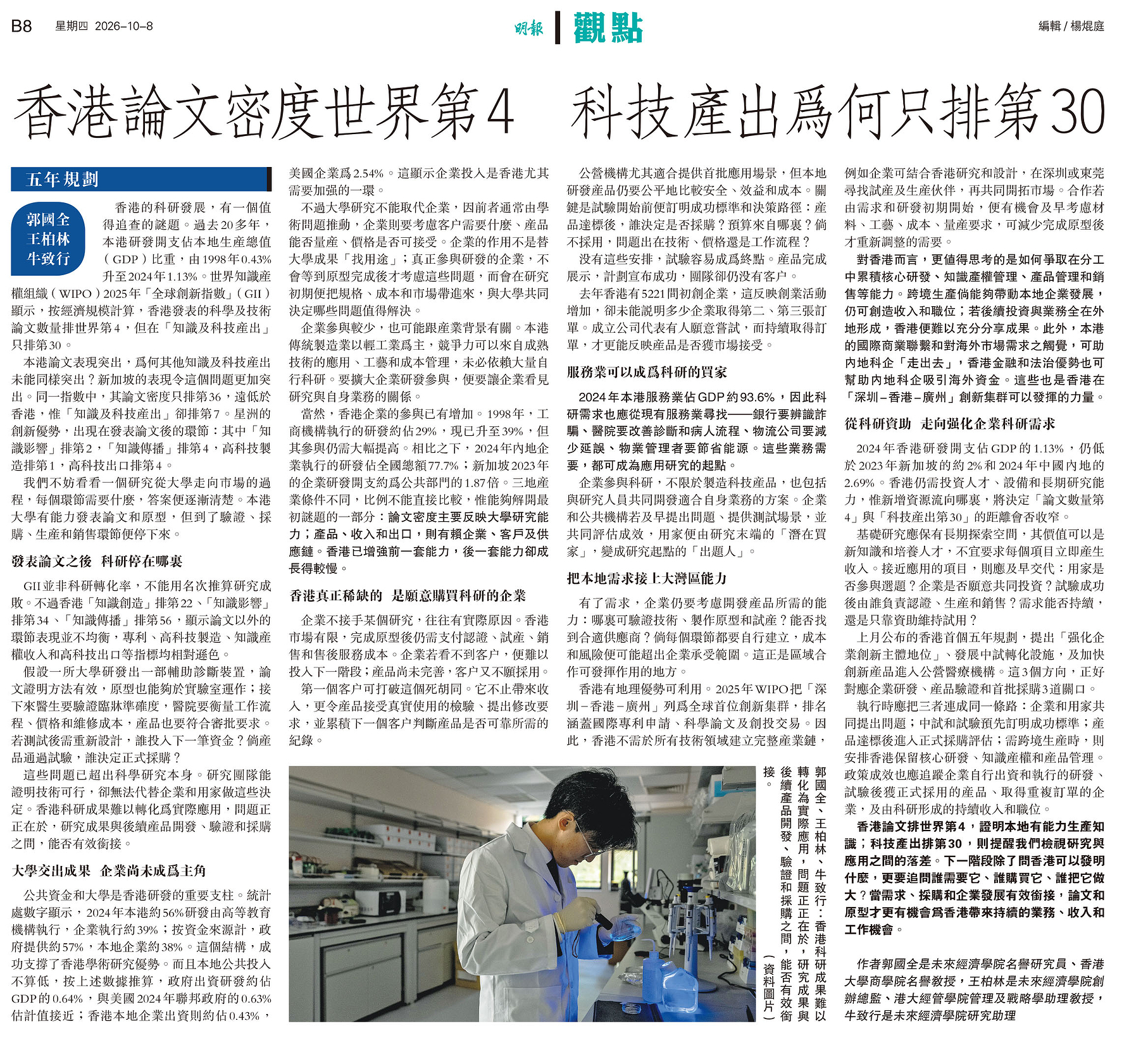
Abstract: Hong Kong ranks fourth globally in research publication density in the 2025 Global Innovation Index, but only 30th in knowledge and technology outputs. The article argues that, while public funding and universities have established a strong research base, business investment and participation in R&D need to grow. Firms should help shape research from the outset, bringing customer needs, costs, production requirements and market considerations into collaboration with universities. Public institutions and service-sector businesses can provide early opportunities for application, supported by clear routes from trials to formal procurement. Hong Kong can also draw on the Shenzhen–Hong Kong–Guangzhou innovation cluster for pilot production, manufacturing and overseas expansion. While preserving room for basic research, policy should place greater emphasis on business co-investment, product adoption, repeat orders, and the sustained income and jobs generated by research.
Hong Kong’s research and development presents a puzzle worth investigating. Over the past two decades, R&D expenditure as a share of gross domestic product (GDP) has risen from 0.43% in 1998 to 1.13% in 2024. According to the World Intellectual Property Organization’s (WIPO) Global Innovation Index (GII) 2025, Hong Kong ranks fourth globally for scientific and technical publications relative to the size of its economy, but only 30th in “Knowledge and technology outputs”.
Why has Hong Kong’s strong publication performance not been matched by similarly strong results in other knowledge and technology outputs? Singapore makes the contrast even more striking. In the same index, it ranks only 36th in research publication density, well below Hong Kong, yet seventh in knowledge and technology outputs. Singapore’s innovation strengths lie in the stages beyond publication: it ranks second in “Knowledge impact”, fourth in “Knowledge diffusion”, first in high-tech manufacturing and fourth in high-tech exports.
Consider the journey of a research project from university to market, and what each stage requires. The answer gradually becomes clearer. Hong Kong’s universities can publish papers and develop prototypes, but progress stalls at validation, procurement, production and sales.
After Publication, Where Does Research Stall?
The GII is not a measure of research commercialisation rates, and rankings cannot tell us whether individual research projects succeed or fail. Nevertheless, Hong Kong’s rankings of 22nd in knowledge creation, 34th in knowledge impact and 56th in knowledge diffusion reveal an uneven performance beyond publications. Its results in patents, high-tech manufacturing, intellectual property receipts and high-tech exports are all comparatively weaker.
Suppose a university develops a device to assist medical diagnosis. A paper demonstrates that the method works, and a prototype functions in the laboratory. Doctors must then validate its clinical accuracy. Hospitals must assess how it fits into their workflows, its price and its maintenance costs. The product must also meet regulatory requirements. If testing reveals a need for redesign, who provides the next round of funding? If the product passes its trials, who decides whether to purchase it?
These questions extend beyond scientific research itself. Researchers can demonstrate technical feasibility, but they cannot make these decisions on behalf of businesses and users. Hong Kong’s difficulty in translating research into practical applications centres on whether research can connect effectively with subsequent product development, validation and procurement.
Universities Deliver Research, but Businesses Have Yet to Take the Lead
Public funding and universities are important pillars of Hong Kong’s R&D system. According to the Census and Statistics Department, higher education institutions performed approximately 56% of Hong Kong’s R&D in 2024, while businesses performed about 39%. By source of funding, the government contributed around 57% and local businesses around 38%. This structure has successfully supported Hong Kong’s academic research strengths.
Nor is local public investment particularly low. Calculations based on these figures put government-financed R&D at approximately 0.64% of GDP, close to the estimated 0.63% financed by the US federal government in 2024. R&D financed by local businesses in Hong Kong accounted for approximately 0.43% of GDP, compared with 2.54% financed by businesses in the United States. This indicates that business investment is an area in which Hong Kong particularly needs to strengthen its efforts.
University research cannot, however, substitute for businesses. Academic research is typically driven by scholarly questions, whereas firms must consider what customers need, whether a product can be manufactured at scale and whether its price is acceptable. Their role is not simply to “find a use” for university research. Businesses that participate meaningfully in R&D do not wait until a prototype is complete before considering these questions. They bring specifications, costs and market considerations into the research process from the outset, working with universities to determine which problems are worth solving.
Limited business participation may also reflect Hong Kong’s industrial background. The city’s traditional manufacturing base was predominantly light industry, where competitiveness could come from applying established technologies, improving production techniques and managing costs, without necessarily relying on substantial in-house scientific research. Expanding business participation in R&D therefore requires firms to see how research relates to their own operations.
Business participation has, of course, increased. In 1998, businesses performed about 29% of Hong Kong’s R&D; that share has since risen to 39%. Yet their involvement still needs to expand substantially. By comparison, businesses performed 77.7% of mainland China’s total R&D in 2024, while Singapore’s business R&D expenditure in 2023 was approximately 1.87 times that of its public sector.
The three economies have different industrial structures, so these ratios are not directly comparable. Nevertheless, they help explain part of the original puzzle. Research publication density primarily reflects universities’ research capabilities, while products, revenue and exports depend on businesses, customers and supply chains. Hong Kong has strengthened the former set of capabilities, while the latter has developed more slowly.
What Hong Kong Really Lacks Is Businesses Willing to Buy the Results of Research
Businesses often have practical reasons for declining to take a research project forward. Hong Kong’s market is limited, and even after a prototype is completed, firms must still pay for certification, pilot production, sales and after-sales service. Without a clear prospect of customers, businesses struggle to invest in the next stage. Yet customers are reluctant to adopt a product that is not fully developed.
The first customer can break this deadlock. Beyond generating revenue, that customer puts the product to the test in actual use, requests improvements and helps build the track record that subsequent customers need to judge its reliability.
Public institutions are particularly well placed to provide early opportunities for application. Locally developed products must nevertheless be assessed fairly against alternatives in terms of safety, effectiveness and cost. The key is to establish success criteria and a decision-making process before a trial begins. Once the product meets the required standards, who decides whether to procure it? Where will the budget come from? If it is not adopted, is the obstacle the technology, its price or the workflow?
Without these arrangements, a trial can become the end of the road. A product is demonstrated, the programme is declared a success, but the team still has no customers.
Hong Kong had 5,221 start-ups in 2025. This reflects increased entrepreneurial activity, but it does not tell us how many firms secured their second or third orders. Setting up a company shows a willingness to try. Securing repeat orders is a stronger indication that the market accepts the product.
The Services Sector Can Become a Buyer of Research
Services accounted for approximately 93.6% of Hong Kong’s GDP in 2024. Demand for research should therefore also be sought within the city’s existing service industries. Banks need to detect fraud; hospitals need to improve diagnosis and patient flows; logistics companies need to reduce delays; and property managers need to save energy. These business needs can all provide starting points for applied research.
Business participation in research is not limited to manufacturing technology products. It also includes working with researchers to develop solutions suited to a firm’s own operations. If businesses and public institutions identify problems early, provide settings for testing and jointly assess results, users can move from being “potential buyers” at the end of the research process to helping define the problems at its beginning.
Connecting Local Demand with Greater Bay Area Capabilities
Even where demand exists, businesses must consider the capabilities required to develop a product. Where can they validate the technology, build prototypes and conduct pilot production? Can they find suitable suppliers? If every capability has to be built in-house, the costs and risks may exceed what a firm can bear. This is where regional collaboration can play a role.
Hong Kong has geographical advantages it can draw on. In 2025, WIPO ranked Shenzhen–Hong Kong–Guangzhou as the world’s leading innovation cluster, based on international patent applications, scientific publications and venture capital deals. Hong Kong therefore does not need to build a complete industrial chain in every technological field. Businesses can, for example, combine research and design in Hong Kong with pilot-production and manufacturing partners in Shenzhen or Dongguan, then develop markets together. Collaboration beginning at the stage of identifying needs and conducting research allows materials, production processes, costs and mass-production requirements to be considered early, reducing the need for adjustments after a prototype has been completed.
For Hong Kong, the more important question is how to build capabilities in core R&D, intellectual property management, product management and sales within this division of work. Cross-border production can still generate income and jobs if it supports the growth of local businesses. If subsequent investment and business activity take place entirely elsewhere, however, Hong Kong will struggle to share fully in the benefits.
Hong Kong’s international business connections and understanding of overseas market needs can also help mainland technology companies expand abroad. Its strengths in finance and the rule of law can help those companies attract overseas capital. These are further contributions Hong Kong can make to the Shenzhen–Hong Kong–Guangzhou innovation cluster.
From Funding Research to Strengthening Business Demand for R&D
Hong Kong’s R&D expenditure of 1.13% of GDP in 2024 remained below Singapore’s approximately 2% in 2023 and mainland China’s 2.69% in 2024. The city must continue investing in talent, equipment and long-term research capabilities. Where additional resources are directed, however, will determine whether the gap between fourth place in research publication density and 30th in technology outputs narrows.
Basic research must retain room for long-term exploration. Its value may lie in generating new knowledge and developing talent; not every project should be expected to produce immediate revenue. Projects closer to application, however, should address several questions early. Have users helped define the research questions? Are businesses willing to co-invest? If trials succeed, who will take responsibility for certification, production and sales? Can demand be sustained, or does continued trial use depend entirely on subsidies?
Hong Kong’s first Five-Year Plan, released in September 2026, proposed strengthening the central role of enterprises in innovation, developing pilot-production and commercialisation facilities, and accelerating the introduction of innovative products into public healthcare institutions. These three directions correspond to three critical stages: business R&D, product validation and initial procurement.
Implementation should connect them into a single process. Businesses and users should jointly identify problems. Pilot production and trials should have predefined success criteria. Products that meet those criteria should proceed to formal procurement assessment. Where cross-border production is needed, arrangements should ensure that Hong Kong retains core R&D, intellectual property and product management functions.
Policy evaluation should also track R&D financed and performed by businesses, products formally adopted after trials, firms securing repeat orders, and the sustained income and jobs generated by research.
Hong Kong’s fourth-place ranking in research publication density demonstrates its ability to generate knowledge. Its 30th-place ranking in knowledge and technology outputs reminds us to examine the gap between research and application. In the next stage, we must ask not only what Hong Kong can invent, but also who needs it, who will buy it and who will scale it up. When demand, procurement and business development are effectively connected, papers and prototypes stand a better chance of generating sustained business activity, income and jobs for Hong Kong.
Kwok-chuen Kwok is an Honorary Fellow of the Hong Kong Future Economy Institute and an Honorary Professor at HKU Business School. Michael B. Wong is the Founding Director of the Hong Kong Future Economy Institute and an Assistant Professor in Management and Strategy at HKU Business School. Alex Ngau is a Research Associate at the Hong Kong Future Economy Institute.
(Translation supported by AI)