July 16, 2026 · 《MingPao》
A young couple in their early thirties earning a combined monthly income of HK$45,000 is hardly unusual in Hong Kong. They have stable jobs and are eligible to apply for a Home Ownership Scheme flat under the White Form category. Yet after paying rent, insurance premiums, household contributions and other daily expenses, even if they manage to save HK$5,000 a month, it would still take them more than four years to accumulate the down payment for a HK$2.5 million HOS flat.
Four years later, would they still choose to move to the Northern Metropolis? Would they still plan to marry, have children and build a family there?
This is not a hypothetical scenario. It reflects the predicament facing a generation of young Hongkongers confronted by a broken homeownership ladder.
The Northern Metropolis is the largest development project in Hong Kong’s history. It is expected to provide 500,000 new housing units, supported by major infrastructure and development projects including the Northern Link, San Tin Technopole, the Hong Kong–Shenzhen Innovation and Technology Park in the Loop, and the Hung Shui Kiu New Development Area. But a new metropolis does not emerge automatically simply because buildings and railways have been constructed.
Whether the Northern Metropolis can ultimately become Hong Kong’s new economic engine depends on a more fundamental question: will enough people, particularly young working families, be willing to move there, stay there and write the next chapter of their lives there?
Over the past decade, Hong Kong’s population aged 18 to 39 has fallen by approximately 325,000. The working population aged 20 to 39 declined by 250,000 in just seven years—an alarming figure.
Talent admission schemes have undoubtedly helped fill some of the gap. However, community networks, institutional knowledge and social cohesion ultimately depend on whether locally raised young people are willing to remain in Hong Kong, pursue their careers and form families here. Affordable housing is a crucial condition for encouraging them to stay.
Between 2002 and 2023, the proportion of people aged 30 to 39 who owned private housing fell from 31.3% to 23.4%. The proportion owning subsidised sale flats dropped even more sharply, from 12.4% to just 6.2%. Over the same period, the proportion living with their parents surged from 26.7% to 40.5%.
The traditional housing ladder—from renting, to applying for subsidised housing, to owning a home—has become increasingly unstable. For many young people, the problem is not that they cannot afford the monthly mortgage repayments. It is that they cannot overcome the barriers of the down payment and the ballot.
History shows that subsidised homeownership is not merely a welfare measure. It is also a catalyst for attracting residents to new towns. Many of the early residents of Sha Tin and Ma On Shan were young families who purchased HOS flats. They brought a stable residential population and created sustained demand for schools, shops, transport and community services.
The Northern Metropolis is far larger than any single new town developed in the past. At an early stage of its development, it therefore needs to attract a substantial group of young residents who are economically active, willing to purchase homes and likely to settle there for the long term.
HOS supply has improved in recent years. The average oversubscription rate has fallen from a peak of around 40 times to 15 times, while the success rate for White Form applicants has risen to 5.5%. The Government has also introduced a youth quota and additional ballot numbers.
However, “being able to win the ballot” is only the first hurdle. For young White Form applicants, the more immediate challenge is raising a sizeable down payment within a relatively short period.
The down payment is the real barrier
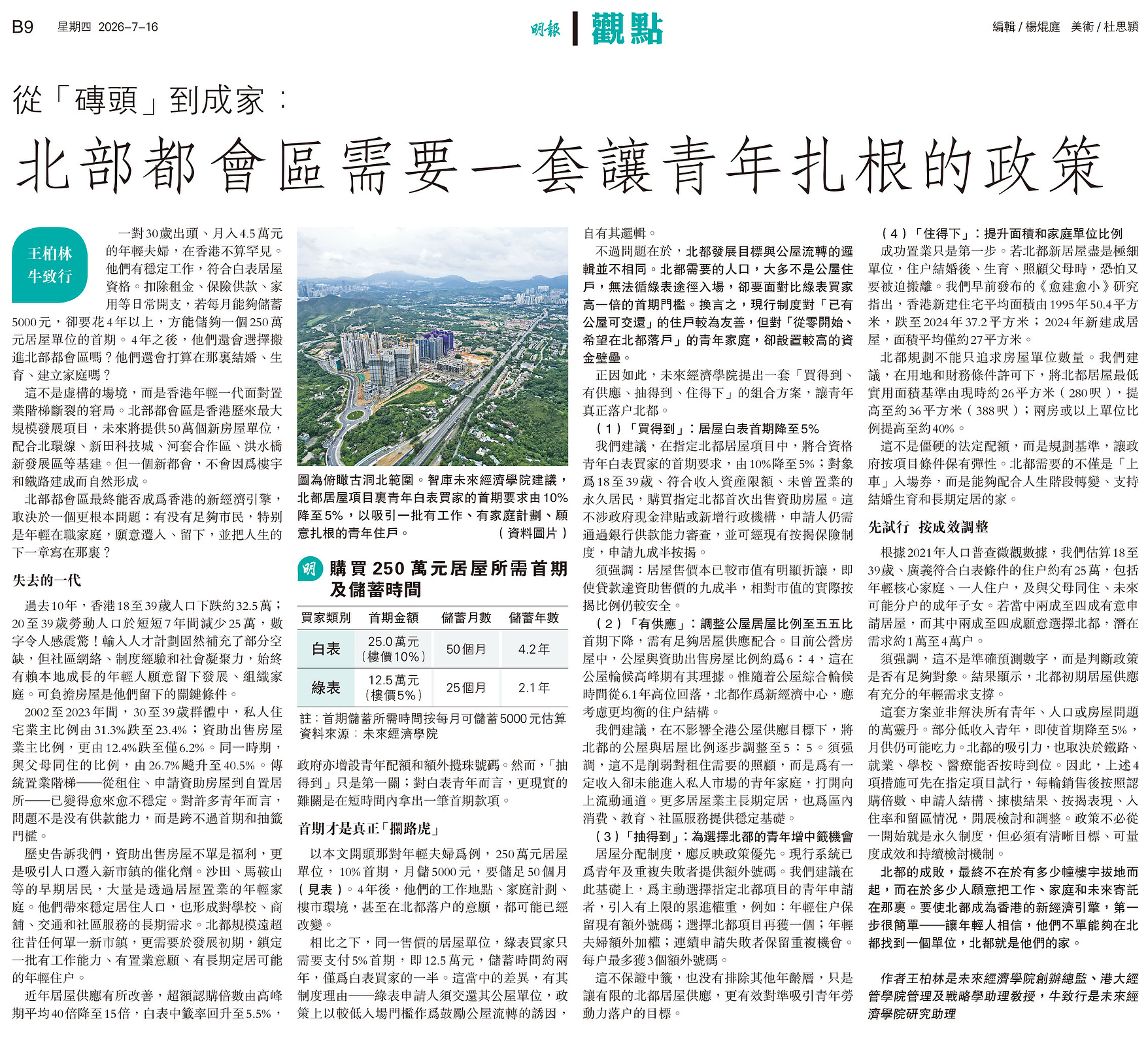
Consider the young couple introduced at the beginning of this article. For a HK$2.5 million HOS flat requiring a 10% down payment, they would need to save HK$5,000 a month for 50 months.
Four years later, their place of work, family plans, the property market and even their willingness to settle in the Northern Metropolis may all have changed.
By comparison, a Green Form buyer purchasing an HOS flat at the same price is required to pay only a 5% down payment, or HK$125,000. The saving period would be approximately two years—only half as long as that faced by a White Form buyer.
There is an institutional rationale behind this difference. Green Form applicants are required to surrender their public rental housing units. A lower entry threshold therefore serves as an incentive to encourage the turnover of public housing resources.
The problem, however, is that the development objectives of the Northern Metropolis are different from the logic of public housing turnover. Most of the people the Northern Metropolis needs to attract are not public housing tenants. They cannot enter the market through the Green Form route, yet they face a down-payment requirement twice as high as that imposed on Green Form buyers.
In other words, the current system is more accommodating to households that already have a public housing unit to surrender, while imposing a higher financial barrier on young families starting from scratch and hoping to settle in the Northern Metropolis.
For this reason, the Hong Kong Future Economy Institute has proposed a four-part policy package—Buyable, Available, Winnable and Liveable—to enable young people to put down roots in the Northern Metropolis.
1. Buyable: reduce the White Form down payment to 5%
We recommend reducing the down-payment requirement for eligible young White Form buyers from 10% to 5% in designated HOS developments in the Northern Metropolis.
Eligible applicants would be permanent residents aged 18 to 39 who meet the relevant income and asset limits, have never owned property and are purchasing newly offered subsidised sale housing in designated Northern Metropolis projects.
The proposal would not involve a cash subsidy from the Government or the creation of a new administrative body. Applicants would still be required to pass banks’ mortgage affordability assessments and could apply for a mortgage of up to 95% under the existing mortgage guarantee arrangements.
It should also be emphasised that HOS flats are already sold at a substantial discount to market value. Even if the mortgage amounts to 95% of the subsidised sale price, the effective loan-to-value ratio relative to the market value of the flat would remain comparatively prudent.
2. Available: move towards a 50:50 split between public rental and subsidised sale housing
A lower down payment must be matched by an adequate supply of HOS flats.
At present, the ratio between public rental housing and subsidised sale housing in the public housing programme is approximately 60:40. This was justified when the waiting time for public rental housing was at its peak. However, as the composite waiting time has fallen from its high of 6.1 years, a more balanced resident mix should be considered for the Northern Metropolis as a new economic centre.
We recommend gradually adjusting the ratio between public rental housing and HOS flats in the Northern Metropolis to 50:50, without affecting the territory-wide target for public rental housing supply.
This would not weaken support for households in genuine need of rental accommodation. Rather, it would open a pathway for upward mobility for young families with a certain level of income who are nevertheless unable to enter the private housing market.
A larger and more stable population of HOS homeowners would also provide a stronger foundation for local consumption, education and community services.
3. Winnable: improve the chances of young applicants who choose the Northern Metropolis
The HOS allocation system should reflect policy priorities.
The current system already provides additional ballot numbers for young applicants and those who have repeatedly been unsuccessful. Building on these arrangements, we recommend introducing a capped, progressive weighting mechanism for young applicants who actively select designated Northern Metropolis projects.
For example, young households could retain the additional ballot number already available to them; applicants choosing Northern Metropolis projects could receive another; young married couples could receive additional weighting; and repeat applicants could retain enhanced chances after successive unsuccessful applications. Each household could receive up to three additional ballot numbers.
This would not guarantee success, nor would it exclude applicants from other age groups. It would simply align the limited supply of HOS flats in the Northern Metropolis more closely with the policy objective of attracting young workers to settle there.
4. Liveable: increase unit sizes and the share of family-sized flats
Successful homeownership is only the first step.
If newly built HOS flats in the Northern Metropolis are overwhelmingly very small units, residents may be forced to move away when they marry, have children or need to care for their parents.
Our earlier study, Smaller and Smaller, found that the average size of newly completed homes in Hong Kong fell from 50.4 square metres in 1995 to 37.2 square metres in 2024. Newly completed HOS flats in 2024 had an average size of only about 27 square metres.
Planning for the Northern Metropolis should not focus solely on the number of housing units delivered.
Subject to land and financial constraints, we recommend raising the minimum saleable-area planning benchmark for HOS flats in the Northern Metropolis from approximately 26 square metres, or 280 square feet, to around 36 square metres, or 388 square feet. We also recommend increasing the proportion of two-bedroom or larger units to approximately 40%.
This would not be a rigid statutory quota, but a planning benchmark that allows the Government to retain flexibility according to the conditions of individual projects.
What the Northern Metropolis needs is not merely an entry ticket onto the housing ladder, but homes that can accommodate changing life stages and support marriage, childbearing and long-term settlement.
Pilot first and adjust according to outcomes
Using microdata from the 2021 Population Census, we estimate that there are approximately 250,000 households aged 18 to 39 that broadly meet the White Form eligibility criteria. These include young nuclear families, one-person households and adult children living with their parents who may form separate households in the future.
If 20% to 40% of these households are interested in applying for HOS flats, and 20% to 40% of that group are willing to choose the Northern Metropolis, potential demand would amount to approximately 10,000 to 40,000 households.
This should not be interpreted as a precise forecast. Rather, it is intended to assess whether the proposed policy would have a sufficiently large target population. The results indicate that the initial supply of HOS flats in the Northern Metropolis would be supported by substantial demand among young households.
This policy package is not a panacea for every challenge relating to youth, population or housing. Some lower-income young people may still struggle with monthly mortgage repayments even if the down payment is reduced to 5%.
The attractiveness of the Northern Metropolis will also depend on whether railways, employment opportunities, schools and healthcare facilities are delivered on schedule.
The four measures should therefore first be piloted in designated projects. After each sales exercise, the Government should review and adjust the arrangements based on oversubscription rates, applicant profiles, flat-selection outcomes, mortgage performance, occupancy rates and the proportion of residents who remain in the district.
A policy does not need to be permanent from the outset. It does, however, need clear objectives, measurable outcomes and a mechanism for continuous review.
Ultimately, the success of the Northern Metropolis will not be measured by how many buildings rise from the ground, but by how many people are willing to entrust their careers, families and futures to the area.
To make the Northern Metropolis Hong Kong’s new economic engine, the first step is simple: young people must believe that they will not merely be able to find a flat there—the Northern Metropolis can become their home.
(Translation supported by AI)