
Latest Articles
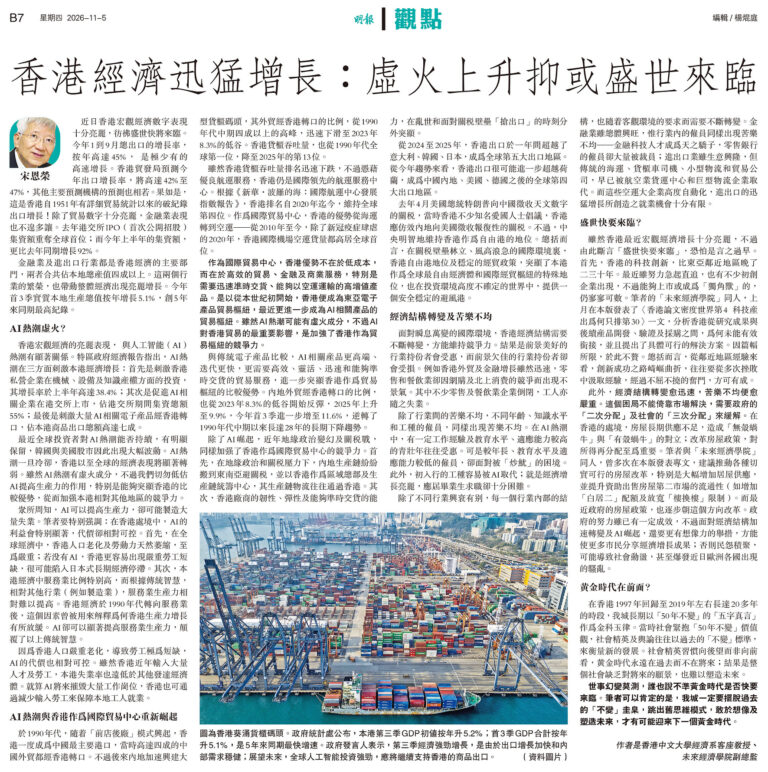
Hong Kong’s Surging Economy: An Overheated Boom or the Dawn of a New Era of Prosperity?
Hong Kong’s strong export, financial-sector and GDP growth has been driven in significant part by the artificial intelligence boom. This article argues that, despite the risk of overheating, AI offers particular benefits for Hong Kong by raising productivity in its service-dominated economy and easing labour shortages caused by population ageing. Trade in high-value AI-related products, together with supply-chain restructuring, geopolitical shifts and tariff pressures, has reinforced Hong Kong’s comparative advantages in air cargo, trade coordination and professional services, while highlighting the value of its free-port status and stable trade and economic policies. Yet the gains remain unevenly distributed. Retail, catering,…
Could Hong Kong Benefit from the Global Economic Turmoil Caused by Trump?
Since taking office, Trump has launched a global tariff war and stirred up turmoil in the Middle East. This article analyses the impact on Hong Kong of these two global economic disruptions — the 2025 tariff war and the ongoing Middle East war. While the tariff war has brought unexpected benefits to Hong Kong through capital inflows and trade rerouting, the Middle East war presents a more complex picture, with both risks (oil-price inflation, higher interest rates) and opportunities (capital diversion from the Gulf region) for Hong Kong as an international financial centre and trade hub.
Does Hong Kong's Long Economic Night Have a Dawn? (Part 2)
Hong Kong's economic crisis, now stretching into its sixth year, is the longest recession on record. While recent government measures have produced some bright spots — the talent-grab scheme, a rebound in population, and a rise in regional headquarters — it remains unclear whether these can truly dispel the long economic night and bring a dawn.
Does Hong Kong's Long Economic Night Have a Dawn? (Part 1)
Part 1 of Yun-wing Sung's analysis of Hong Kong's record-long economic recession — comparing it to past crises (1967, 1973, 1983, 1997), examining why government-spending-driven growth cannot be sustained, and warning of deep business pessimism and a widening public-private R&D gap.