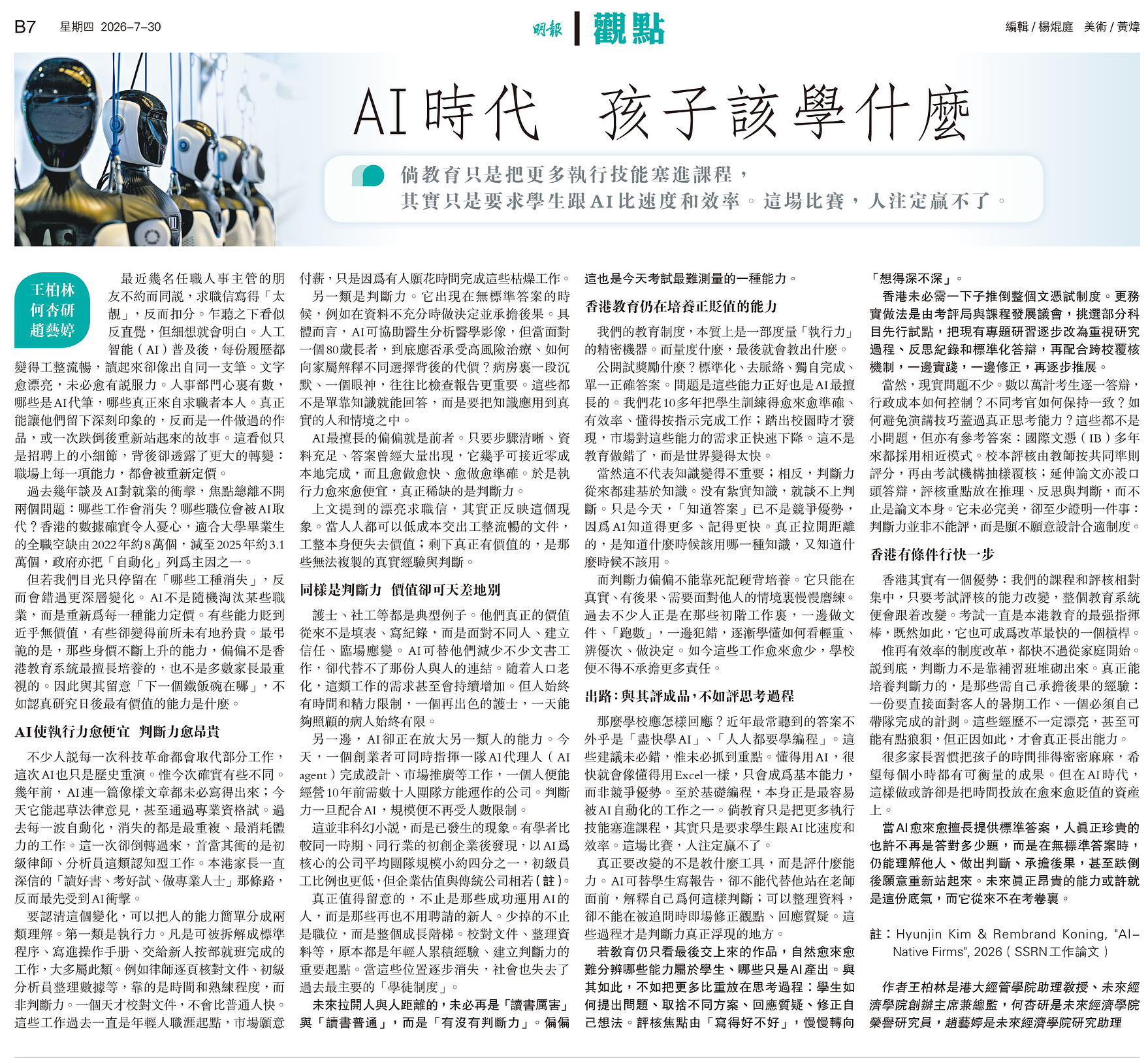
Several friends who head human resources departments have recently made the same observation: a job application letter that is too polished can now count against the candidate.
This may sound counterintuitive, but it makes sense on closer inspection. Since the widespread adoption of artificial intelligence, almost every CV has become polished and fluent, with near-perfect phrasing—and yet they increasingly read as though they were written by the same hand. Better prose is no longer necessarily more persuasive. HR professionals generally have a good sense of what has been written by AI and what genuinely comes from the applicant. What leaves a lasting impression is more likely to be a personal experience, a piece of work the candidate has actually produced, or a story about failing and finding the resolve to begin again.
This may appear to be a minor shift in recruitment practice. In fact, it points to a much larger transformation: every capability in the labour market is being repriced.
In recent years, debate about AI’s impact on employment has revolved around two questions: which jobs will disappear, and which occupations will AI replace? The figures for Hong Kong are indeed troubling. The number of full-time vacancies suitable for university graduates fell sharply from about 80,000 in 2022 to approximately 31,000 in 2025. Vacancies in administration, information technology and junior software development recorded particularly steep declines—of close to 90 per cent and 80 per cent in some categories—with the government identifying automation as one of the principal causes.¹
Yet if we focus only on which occupations are disappearing, we risk missing the deeper transformation. AI is not eliminating jobs at random; it is repricing every kind of human capability. Some are depreciating almost to the point of worthlessness, while others have become more valuable than ever. The paradox is that the capabilities appreciating most rapidly are precisely those that Hong Kong’s education system is least adept at developing—and that many parents value least. Instead of asking where the next secure profession will be found, we should be asking which human capabilities will command the greatest value in the future.
As execution becomes cheaper, judgment becomes more valuable
It is often said that every technological revolution displaces some forms of work, and that AI is simply another turn of the historical cycle.
But this time is different in an important respect. Only a few years ago, AI struggled to produce a competent essay. Today it can draft legal opinions, write functioning software, pass professional examinations and even achieve gold-medal-level results in the International Mathematical Olympiad.² In previous waves of automation, the first jobs to disappear were generally the most repetitive and physically demanding. This time, the pattern has been reversed: cognitive occupations such as junior lawyers, analysts and programmers are among those most immediately exposed. The pathway in which Hong Kong parents have long placed their faith—study hard, excel in examinations and enter a profession—is now among the first to be disrupted by AI.
One way to understand this shift is to divide human capabilities into two broad categories.
The first is execution. This covers most work that can be broken down into standard procedures, written into an operating manual and assigned to a newcomer to complete step by step. Examples include a lawyer reviewing documents page by page, a junior analyst cleaning data and running models, or an employee turning information into a presentation. Such tasks depend primarily on time and proficiency, rather than judgment. A genius does not necessarily proofread documents any faster than an ordinary person. For decades, this work provided young people with an entry point into professional careers. The market paid them largely because somebody had to devote the time to completing these tedious tasks.
The second category is judgment. It becomes necessary when there is no standard answer—when someone must make a decision with incomplete information and accept responsibility for the consequences. AI may, for example, assist in interpreting medical images. But when a doctor sits before an 80-year-old patient, who should decide whether the patient ought to undergo a high-risk treatment? How should the costs of the available options be explained to the family? In a hospital ward, a moment of silence or a glance may convey more than a diagnostic report. Such questions cannot be answered through knowledge alone. They require knowledge to be applied to real people in particular circumstances.
AI happens to excel at the former. Whenever the steps are clear, sufficient data are available and similar answers have appeared many times before, it can complete the task at close to zero marginal cost—and do so with ever greater speed and accuracy. Execution is therefore becoming cheaper. What remains scarce is judgment.
The beautifully written application letter reflects precisely this phenomenon. Once anyone can produce a polished, fluent document at minimal cost, polish itself loses value. What remains valuable are authentic experiences and judgments that cannot be replicated.
Not all forms of judgment are valued equally
Nurses, social workers, counsellors and elderly-care workers are instructive examples. Their real value has never lain in completing forms or writing case notes, but in responding to different people, earning their trust and adapting to circumstances as they unfold. AI can relieve them of much administrative work, but it cannot replace the human connection at the heart of what they do. As societies age, demand for these occupations may continue to grow. Yet human beings remain constrained by time and energy: however capable a nurse may be, there is a limit to the number of patients one person can care for in a day.
At the other end of the spectrum, AI is amplifying the capabilities of a different group. An entrepreneur can now direct a team of AI agents to handle design, software development, marketing, customer service and bookkeeping. A single person may be able to operate a business that would have required dozens of employees a decade ago. Once judgment is combined with AI, scale is no longer constrained by headcount.
This is not science fiction; it is already happening. Comparing start-ups established in the same periods and industries, Kim and Koning find that AI-centred companies have teams that are about a quarter smaller on average, with a lower proportion of junior employees, while achieving valuations comparable to those of conventional firms.³
The most important people to consider are not only those who have used AI successfully, but also the junior employees whom these companies no longer need to hire. What is disappearing is not merely a set of jobs, but an entire career ladder. Reviewing documents, organising data, running models and conducting preliminary analysis were once the entry-level tasks through which young people accumulated experience and developed judgment. As these positions disappear, society is also losing its principal apprenticeship system.
The divide of the future may no longer be between those who excel academically and those who do not, but between those who possess judgment and those who lack it. Unfortunately, judgment is also among the capabilities that today’s examinations find most difficult to measure.
Hong Kong’s education system is still cultivating a depreciating capability
Our education system is, at heart, a highly sophisticated machine for measuring execution. And what we choose to measure inevitably shapes what we teach.
What do public examinations reward? Standardisation, decontextualised questions, independent work and the identification of a single correct answer. The problem is that these are precisely the capabilities at which AI excels. For more than a decade, we train students to become increasingly accurate, increasingly efficient and increasingly capable of following instructions. Yet by the time they leave school, the market’s demand for precisely these abilities is declining rapidly. This does not mean that education has failed. It means that the world has changed faster than education has.
None of this suggests that knowledge has become less important. On the contrary, judgment has always rested upon knowledge. Without a solid command of a subject, meaningful judgment is impossible. The difference is that knowing the answer is no longer a competitive advantage: AI knows more and retrieves it faster. What distinguishes one person from another is knowing which knowledge to apply, when to apply it—and when not to.
Judgment cannot be developed through rote learning. It can only be cultivated gradually in real situations, where decisions have consequences and other people must be faced. In the past, many professionals learnt to distinguish what mattered, set priorities and make decisions while preparing documents, running calculations and making mistakes in junior roles. As such work becomes scarcer, schools will inevitably have to assume more of this responsibility.
The way forward: assess the thinking, not merely the product
How, then, should schools respond? The most common answers in recent years have been that students should learn to use AI as quickly as possible and that everyone should learn to code. These suggestions are not necessarily wrong, but they miss the central issue. The ability to use AI will soon resemble proficiency in Excel: a basic requirement rather than a competitive advantage. Basic programming, meanwhile, is itself among the forms of work most readily automated by AI. If education merely adds more execution skills to the curriculum, it is effectively asking students to compete with machines on speed and efficiency—a contest human beings are destined to lose.
What must change is not primarily the tools we teach, but the capabilities we assess. AI can write a report for a student, but it cannot stand before the teacher and explain why the student reached a particular judgment. It can organise evidence, but it cannot revise the student’s position in real time when challenged, or respond convincingly to scrutiny. It is in these moments that judgment becomes visible.
If education continues to assess only the final product, it will become increasingly difficult to distinguish what the student can do from what AI has produced. A better approach would assign greater weight to the process of thinking: how students formulate questions, weigh competing options, respond to criticism and revise their ideas. The emphasis of assessment should gradually shift from how well a student writes to how deeply the student thinks.
Hong Kong need not dismantle the entire Diploma of Secondary Education examination system at once. A more pragmatic approach would be for the Hong Kong Examinations and Assessment Authority and the Curriculum Development Council to select a small number of subjects for pilot programmes. Existing project work could gradually be redesigned to give greater weight to the research process, reflective records and standardised oral defences, supported by cross-school moderation. The model could then be refined through practice before being introduced more widely.
There are, of course, formidable practical questions. How can the administrative cost of conducting individual oral defences for tens of thousands of candidates be contained? How can consistency between examiners be maintained? How can the system prevent polished presentation skills from obscuring the quality of the underlying thought? These are not minor concerns. Yet there are models from which Hong Kong can learn. The International Baccalaureate has used comparable arrangements for many years. Teachers assess school-based work against common criteria, while the examination body reviews samples for moderation. The extended essay also includes an oral component, with attention paid to reasoning, reflection and judgment rather than solely to the written paper.⁴ The system is not perfect, but it demonstrates an important point: judgment is not impossible to assess. The question is whether we are prepared to design an assessment system capable of doing so.
Hong Kong is well placed to move ahead
Hong Kong has an important advantage. Its curriculum and assessment system are relatively centralised. If examinations begin to reward different capabilities, the rest of the education system will follow. Examinations have always been the most powerful steering mechanism in Hong Kong education. That same influence could now make them the most effective lever for reform.
Yet even the most efficient institutional reform cannot move as quickly as change that begins in the family. Judgment, after all, cannot be accumulated through private tutoring. It develops through experiences in which young people must bear the consequences of their own decisions: a summer job that requires them to deal directly with customers, a project for which they must lead a team, or a collaboration that fails and leaves them responsible for putting things right. Such experiences may not look impressive. They may even be messy or uncomfortable. But that is precisely why they build genuine capability.
Many parents fill every hour of their children’s schedules in the hope that each one will produce a measurable result. In the age of AI, however, this may amount to investing ever more heavily in an asset whose value is steadily depreciating.
As AI becomes increasingly adept at supplying standard answers, what makes human beings valuable may no longer be the number of questions they answer correctly. It may instead be their capacity to understand others, exercise judgment and accept responsibility when no standard answer exists—and, when they fail, to find the courage to get back up and try again.
That quiet confidence may prove to be the most valuable capability of all. And it has never appeared on an examination paper.
(Translation supported by AI)