Throughout the history of human education, people have pursued the ideal of teaching each student according to their individual aptitude. More than 2,000 years ago, Confucius advocated “education for all without distinction”: regardless of ability or family wealth, everyone should have an equal opportunity to receive an education and be nurtured. It remains one of education’s highest ideals today. Yet why, after 2,000 years, has it remained an ideal rather than become reality?
The answer is simple. Personalised education has never been a problem of principle; it has been a problem of cost. Historically, very few people have truly enjoyed it. Alexander the Great received one-to-one instruction from the philosopher Aristotle; the British philosopher John Stuart Mill had his entire course of learning personally designed by his father; and the French mathematician Blaise Pascal’s father arranged his education around his interests. What these figures shared was not so much exceptional talent as access to sufficient resources: each had a teacher who could devote almost all of his time to one individual.
Historically, Personalised Education Was an Aristocratic Luxury
The essence of personalised education is a high degree of individualisation, and a high degree of individualisation is expensive. For most of human history, education itself was a luxury. Ordinary families often struggled even to send their children to school, let alone secure an education designed specifically for them. Personalised education has always existed, but only for a very small minority.
In the eighteenth and nineteenth centuries, the Industrial Revolution and the rise of the nation-state changed this situation. Prussia was the first to establish a modern public education system, which subsequently influenced Britain, the United States, Japan and elsewhere. For the first time, education was transformed from a privilege enjoyed by the few into a universal public service. This was unquestionably a major advance for civilisation, giving more people the opportunity to become literate, pursue an education and move beyond the social class into which they were born.
The Price of Universal Education: Standardisation in the Classroom
Yet every advance comes at a cost. For anything to become universal, it must first be affordable. Education was made cheaper through standardisation: a common curriculum, common textbooks, a common pace and common examinations. From society’s perspective, this was a worthwhile bargain—society traded “teaching everyone in the same way” for “being able to educate everyone”. The price, however, was that teachers could no longer truly grasp each student’s day-to-day learning journey.
Education therefore began to rely on examinations to understand students. Examinations are a remarkable invention: they allow teachers to grasp the performance of large numbers of students within a limited time. But they can tell us only what score a student ultimately achieved; they can hardly enable teachers to truly “see” how that student learns.
Even though educational resources are far richer today than they were a century ago, this constraint remains. Teachers are not superhuman. One teacher must face dozens of students, and there are only so many hours in the day, let alone enough time to observe, one by one, where each student gets stuck while solving a problem and how each mistake develops. Hong Kong has implemented small-class teaching since 2009 precisely to reduce the student-teacher ratio and give teachers more room. Yet when it comes to personalised education, the difference between a class of 25 and one of 30 is limited.
The more fundamental problem is that traditional education can understand students only through the narrow window of examinations. Examination results reflect only whether the final answer is right or wrong; they cannot explain at which step a student first lost their way, or how the line of reasoning in the student’s mind took shape, one step at a time. On top of that, lesson preparation, marking assignments, administrative duties and other day-to-day work already consume all of a teacher’s time. How, then, can teachers find the time to “impart knowledge, teach and resolve doubts” for every student?
AI Makes Personalised Education at Scale Possible
Today, we may for the first time be standing at another turning point. Many people assume that the greatest value of artificial intelligence (AI) in education lies in its ability to answer questions, mark essays or even replace parts of teaching. But if we see AI only as a smarter tool, we may underestimate the real change it can bring.
AI reduces not only the cost of marking assignments, but also the cost of understanding students. The problems a student encounters, the point at which they pause, the kind of prompt that finally enables them to understand, how many times they revise an essay, the abilities that gradually stabilise, and the areas in which they repeatedly go wrong—these traces of learning, which in the past disappeared as soon as the bell rang, can now be preserved continuously through AI. More importantly, AI can go a step further by turning the learning process into data that can be analysed and accumulated, identifying gaps in knowledge and patterns of error, tracking changes in ability, and alerting teachers to which students require intervention.
AI “Sees”; Teachers “Respond”
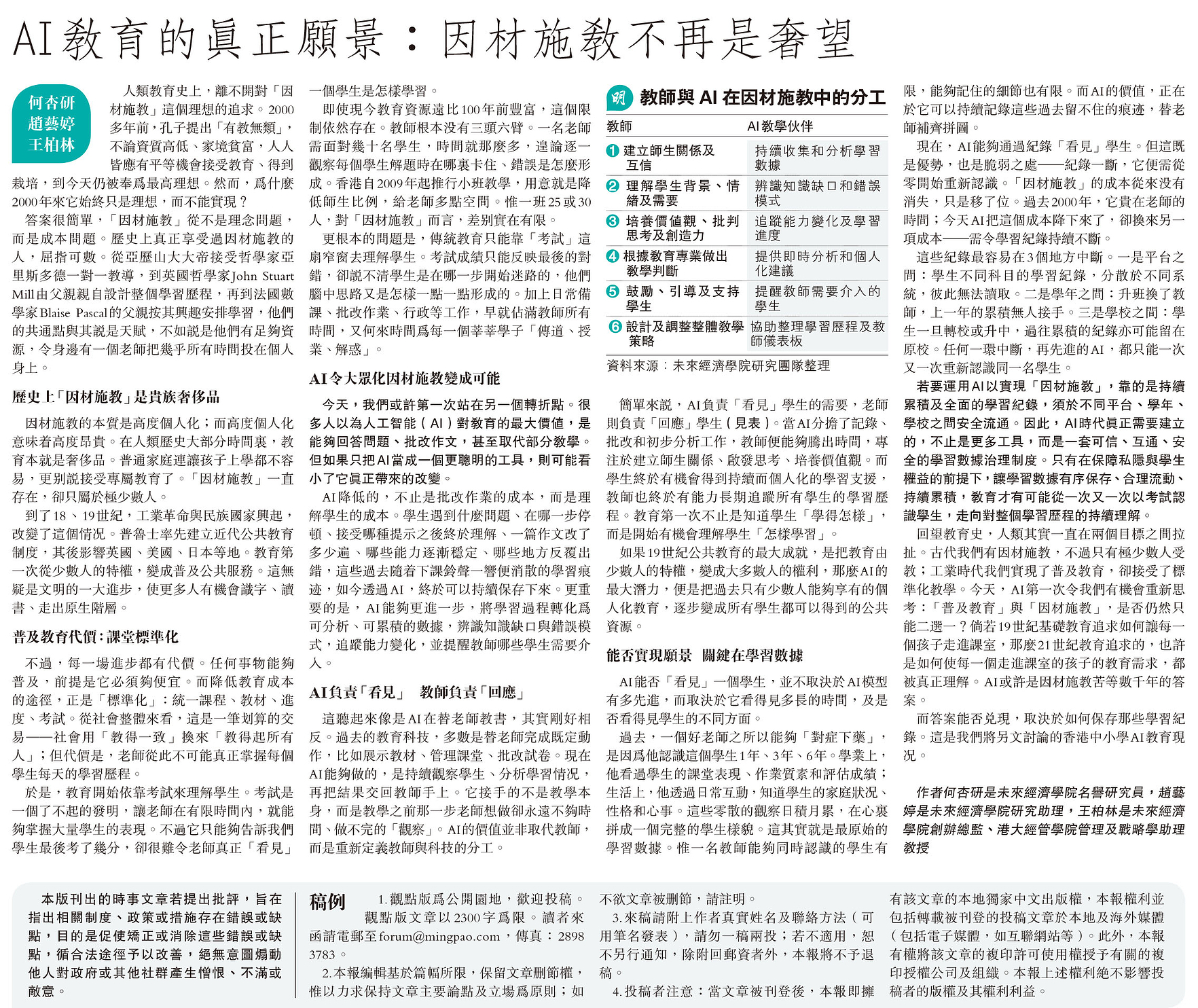
This may sound as though AI is teaching in place of teachers, but the opposite is true. Most earlier educational technologies helped teachers carry out predetermined tasks, such as presenting teaching materials, managing classrooms and marking examination papers. What AI can now do is continuously observe students, analyse how they are learning, and return those findings to teachers. It takes over not teaching itself, but the step that comes before teaching: the “observation” that teachers have always wanted to do but never had enough time to complete. The value of AI is not to replace teachers, but to redefine the division of labour between teachers and technology.
In simple terms, AI is responsible for “seeing” students’ needs, while teachers are responsible for “responding” to them (see table). When AI takes on recording, marking and preliminary analysis, teachers can free up time to focus on building relationships with students, stimulating thought and cultivating values. Students can finally receive continuous, personalised learning support, and teachers can finally track every student’s learning journey over time. For the first time, education can do more than know “how well students are learning”; it can begin to understand “how students learn”.
If the greatest achievement of public education in the nineteenth century was to transform education from a privilege of the few into a right of the majority, then AI’s greatest potential is to turn the personalised education once available only to a small minority, step by step, into a public resource accessible to every student.
Learning Data Is the Key to Realising the Vision
Whether AI can “see” a student does not depend on how advanced the AI model is. It depends on how long it can observe that student and whether it can see the different facets of the student’s life and learning.
In the past, a good teacher could prescribe the right remedy because they had known the student for one year, three years or six years. Academically, the teacher had seen the student’s classroom performance, the quality of their assignments and their assessment results. In the student’s wider life, day-to-day interaction had given the teacher an understanding of their family circumstances, personality and concerns. Accumulated over time, these scattered observations came together in the teacher’s mind to form a complete picture of the student. This was, in fact, the earliest form of learning data. Yet any one teacher can know only a limited number of students at the same time and remember only a limited amount of detail. The value of AI lies precisely in its ability to record continuously the traces that could not previously be retained and to complete the picture for teachers.
Today, AI can “see” students through records. But this is both its strength and its vulnerability: once the continuity of the record is broken, it must begin again from scratch. The cost of personalised education has never disappeared; it has simply moved. For the past 2,000 years, the cost lay in teachers’ time. AI now lowers that cost, but creates another: learning records must remain continuous.
These records are most likely to be interrupted in three places. First, between platforms: a student’s learning records for different subjects are scattered across different systems that cannot read one another’s data. Second, between school years: when a student moves up a year and changes teachers, no one takes over what was accumulated in the previous year. Third, between schools: once a student transfers to another school or moves on to secondary school, the records accumulated in the past may remain at the former school. If the chain is broken at any point, even the most advanced AI can only begin again and again to get to know the same student from scratch.
Using AI to realise personalised education depends on comprehensive learning records accumulated continuously over time and able to flow securely across platforms, school years and schools. What the AI era truly requires, therefore, is not merely more tools, but a trusted, interoperable and secure system of learning-data governance. Only when learning data can be stored systematically, shared appropriately and accumulated continuously—with privacy and students’ rights protected—can education move beyond repeatedly relying on examinations to understand students and towards a sustained understanding of their entire learning journey.
Looking back at the history of education, humanity has always been pulled between two goals. In the ancient world, personalised education existed, but only a tiny minority received it. In the industrial age, we achieved universal education, but accepted standardised teaching. Today, AI gives us the first real opportunity to reconsider whether “universal education” and “personalised education” must still be a binary choice. If nineteenth-century basic education sought to bring every child into the classroom, perhaps the goal of twenty-first-century education is to ensure that the educational needs of every child who enters the classroom are genuinely understood. AI may be the answer for which personalised education has waited thousands of years.
Whether that answer can be realised depends on how those learning records are preserved. This will be the subject of a separate article on the current state of AI education in Hong Kong’s primary and secondary schools.
(Translation supported by AI)