In recent years, the HKSAR Government has committed substantial resources to digital education, public housing supply, the Northern Metropolis (NM), talent development, and innovation and technology (I&T) infrastructure, and key indicators are already improving. The composite waiting time for public rental housing (PRH) is falling, the supply of subsidised sale flats is rising, digital education is spreading, and NM land and infrastructure works are under way. Hong Kong has, in short, laid a strong foundation for the next stage of growth.
The next policy challenge is no longer about how much more funding, units, land, or platforms to deliver, but whether these investments actually improve the real choices available to students, families, talent, and businesses — and translate them into durable institutional capacity. This submission proposes advancing Hong Kong from a model that prizes inputs and volume to an outcome-oriented, institutionally supported model of governance, with recommendations in four areas.
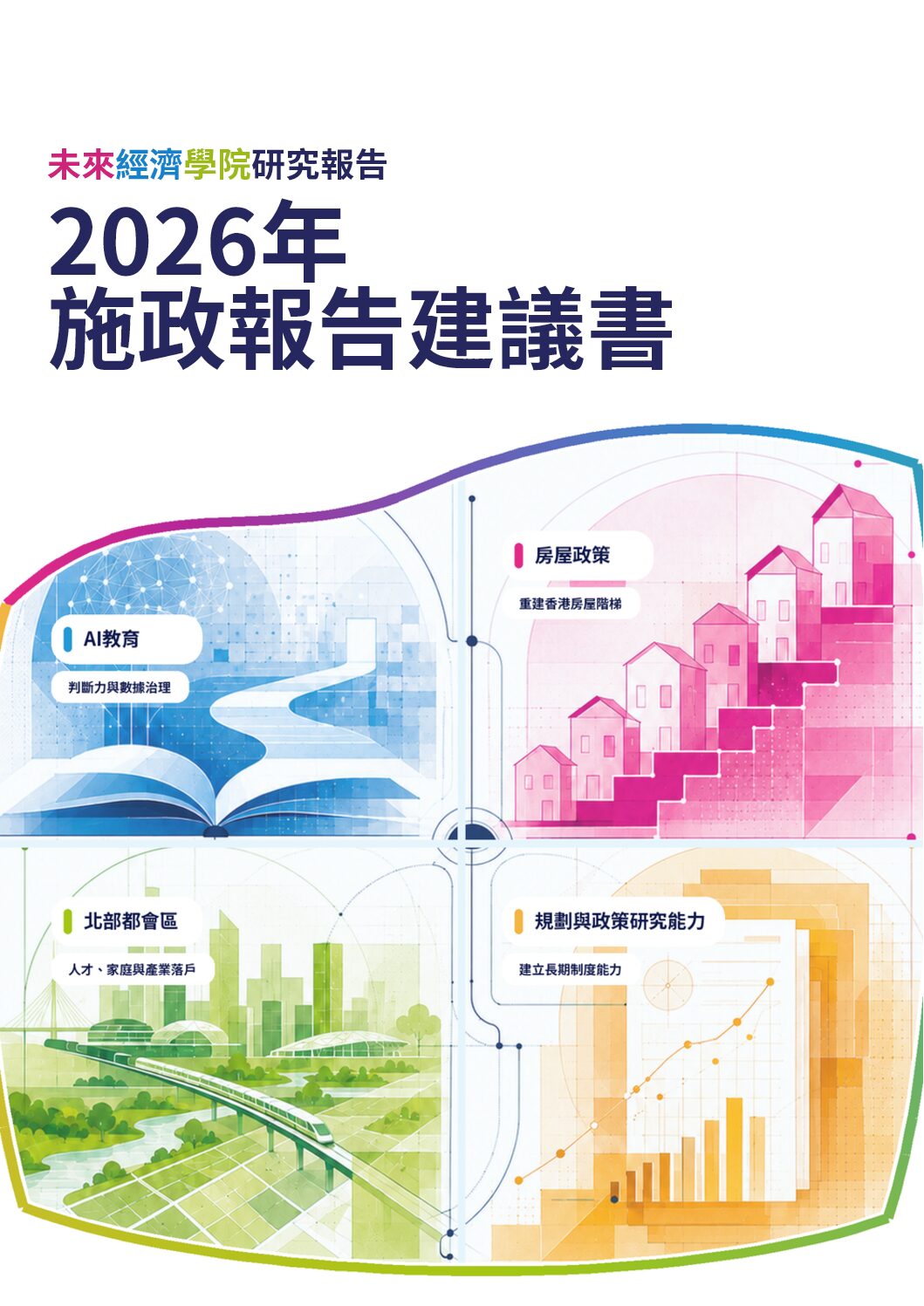
- AI in Education: AI delivers knowledge and answers at speed, making it more important for schools to cultivate students’ ability to question, verify, weigh, decide, and take responsibility. We recommend piloting thinking-process-centred assessment in selected subjects and stages, and building a three-tier AI learning data-governance regime shared by schools, school sponsoring bodies, and cross-sectoral platforms — supported by data standards, common contracts, product evaluation, and school-management training. The goal is for AI to become the educational infrastructure that genuinely supports “teaching in accordance with each student’s aptitude” (因材施教).
- Housing Policy: Housing supply must be measured not just by unit numbers but also by new living space, family-sized supply, and upward mobility. We recommend adding total new internal floor area (IFA), average IFA, and the share of two-bedroom-or-larger units to the principal housing indicators; piloting a 50:50 PRH-to-subsidised-sale split in the NM and other new development areas; raising the White Form Secondary Market Scheme (白居二) quota to 12,000 and gradually phasing out the fixed quota once the market stabilises; and expanding flat-for-flat (樓換樓) and premium-unpaid letting (未補價出租) so households can right-size by family, workplace, and care needs.
- Northern Metropolis: The NM’s success will hinge on whether enterprises, jobs, and families put down lasting roots. We recommend flexible, mixed-use planning; developing the University Town into a live-work ecosystem linking education, research, industry, and residence; and an enterprise-engaged system of vocational and professional education, paid apprenticeships, and cooperative education. A youth settlement package under the principle of “able to buy, with supply, able to draw, and able to live” should combine lower White Form down payments on designated HOS projects, more subsidised sale flats, cumulative ballot weighting, and a higher share of family-sized units. We further recommend piloting distinct development models at Hung Shui Kiu and Ngau Tam Mei.
- Planning and Policy-Research Capacity: Building on the Chief Executive’s Policy Unit and the Administrative Officer (AO) grade, the Government should establish a dedicated planning and policy-research team to complement its capacity in research design, data analysis, scenario projection, and policy evaluation. It should also build a secure administrative-data research environment and a long-term household tracking survey, and use multi-year core funding, open commissioned research, and cross-sectoral talent programmes to create a policy-research regime jointly staffed by the Government, universities, and think tanks.
(Translation supported by AI)